


Vol. XXVI, No. 1, January 2026
- Editor's corner
- LBE strategy of investing in attractions to last for decades has come and gone
- Dave & Buster's continues its downward slide
- What makes experiences special and memorable?
- Changes to location-based entertainment spending in 2024
- A new value equation
- Birthday University February 3rd & 4th
What makes experiences special and memorable?
A previous Leisure eNewsletter article discussed what determines what we remember about an experience and how we judge it, whether positively, negatively, or not at all memorable. A large body of research in the field known as behavioral economics shows that first impressions aren't really all that important in the memories people form of an experience. The research says that the "peak-end rule" determines what we remember about an experience and how we judge it. The peak-end rule says our memory of an experience is determined almost entirely by two things:
- How we feel when the experience is at its peak (most intense emotional point - good or bad), and
- How do we feel at the end of the experience?
We rely on these two-part summaries to form our memory of how we felt about the experience. It's a memory shortcut the brain uses.
We don't remember or judge an experience by the total sum or the average of every moment of its duration.
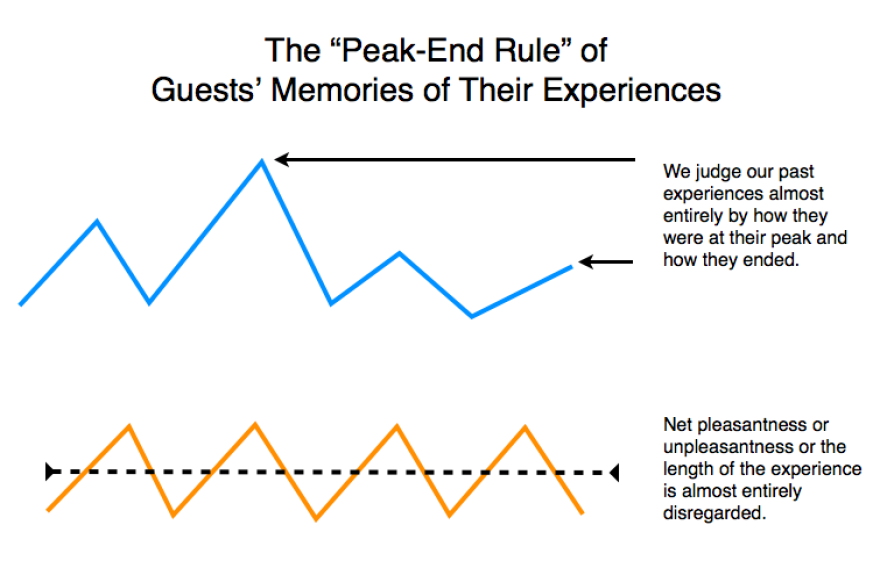
The peak-end effect suggests that when prioritizing a guest experience strategy, it's better to build a higher emotional peak, an ‘aha' moment, rather than increase the number of minor, lesser good moments. It's not the sum or the average that counts, only the peak. It's especially important to get first-time users to experience an emotional peak - they may not come back if the lows are what they remember.
So, what really matters about the memory of visiting a location-based entertainment venue is the emotional intensity of the experience at its peak, combined with what guests experience at the end, rather than the first impression. Even if a minor part of the experience isn't good, people may not remember it if the peak was good and the visit ended happily.
What makes an experience feel deeply special and memorable
Now, along comes some new solid research from a series of studies by Michel Tuan Pham, Kravis Professor of Business at Columbia Business School, and Jennifer J. Sun, an assistant professor at Yonsei University in Korea, on what makes an experience feel deeply special and memorable to a person.
Pham and Sun's findings reveal that specialness isn't necessarily about extravagance or luxury. Instead, it comes down to one or more of three underlying psychological drivers:
- Uniqueness - The research found that most special experiences were not objectively rare. Instead, they felt distinctive to the individual because they were novel, emotionally surprising, or impossible to recreate. Exceeding expectations feeds a sense of uniqueness. A first horseback ride or a dinner that later gained significance because it marked a final moment with a loved one could be just as unique as a bucket-list vacation.
- Meaningfulness - reflects how personally significant an experience feels beyond straightforward enjoyment. One of the most common forms was relational meaningfulness, where the social presence of family or close friends deepens the experience's impact. Others included symbolic meaningfulness, such as proposing at a special place; self-affirming meaningfulness, like attending one's first Pride parade; and transformational meaningfulness, in which a person walked away feeling fundamentally changed, such as learning a new skill or gaining a new perspective.
- Authenticity - Even when consumers don't say it directly, it shows up in how people describe their most memorable moments. An experience feels special when it seems genuine and "real", not fake, forced, or purely commercial. Authentic experiences feel emotionally real and true to the person having them. This might involve visiting a culturally significant location, like a museum exhibit honoring a personal hero. It could also take the form of genuine human warmth.
Often, it is not just one of the three factors, but a combination - something new, shared with someone meaningful, and emotionally genuine - that make an experience stand out as truly special and memorable.
Research's relevance to social gaming venues*
One reason social gaming venues have high appeal is due to their highly social nature of simultaneously combining low-skill level variance analog games, often technology enhanced, with trend-forward, foodie-worthy, globally inspired food, frequently sharable dishes, and curated beverage and alcoholic selections shared with friends or family that creates an extremely meaningful experience, making it special and memorable. The combination of the play, conversation, and shared food and drink create a strong bonding and a more special, unforgettable experience than a purely entertainment one.
* Not all competitive socializing venues qualify as social gaming. See our article discussing the distinction HERE.
Subscribe to monthly Leisure eNewsletter
Vol. XXVI, No. 1, January 2026
- Editor's corner
- LBE strategy of investing in attractions to last for decades has come and gone
- Dave & Buster's continues its downward slide
- What makes experiences special and memorable?
- Changes to location-based entertainment spending in 2024
- A new value equation
- Birthday University February 3rd & 4th