


Vol. XXVI, No. 6, June 2026
- Editor's corner
- A barbell approach to the K-shaped economy
- Alcohol use among teenagers is on the decline
- The number of community location-based entertainment venues continues to grow
- Our company's latest social eatertainment project opens
- The importance of global flavors for social eatertainment venues
- Is your LBE venue seeing real revenue growth?
The importance of global flavors for social eatertainment venues
Globally inspired flavors are no longer a niche add-on in the U.S.; they are a core part of how younger adults, especially Gen Z and Millennials, choose where to eat and drink. For social eatertainment venues of any kind (bowling, darts, arcade bars, golf lounges, axe‑throwing, etc.), the opportunity is not to turn the entire concept into a global restaurant, but to take familiar, shareable formats and give them a smart global twist.
Research shows how mainstream global flavors have become. Datassential reports that 47% of U.S. consumers ate a globally influenced food in the past week, up from 28% in 2017, and that 55% actively choose global foods over other options when dining out. At the same time, 70% of restaurant operators say demand for global flavors has increased, and 74% believe globally influenced dishes can support higher price points. These figures indicate that global flavors are both widely adopted and commercially valuable.
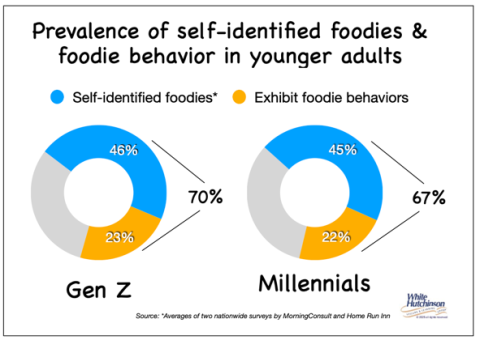
Gen Z and Millennials are driving much of this growth. Our company's research finds that 2/3rds of adult Gen Z and Millennials are Food Adventurers who exhibit foodie behaviors, such as food adventurism and discovery, even if they don't identify as foodies and post meals on social media. They gravitate toward bolder, more diverse flavor experiences and are especially receptive to dishes that blend familiarity with global influences. Think fusion in a grounded way rather than gimmicks. They also bring expectations from the broader dining market into social venues. If they can get Korean wings, elote fries, and yuzu cocktails at a neighborhood bar, they expect similar energy from a place where they bowl, throw axes, or play darts.
For social entertainment, the most practical strategy is to keep the core menu familiar and game-friendly, including sliders, fries, flatbreads, wings, tacos, wraps, snack boards, and bite-size desserts, and then layer in global-inspired flavors. A useful target is to have roughly 25% to 40% of food items feature global-inspired or global-fusion flavors, with the rest serving as classic anchors with broad appeal. This keeps ordering simple for cautious guests while delivering enough variety and discovery to excite younger, more adventurous diners.
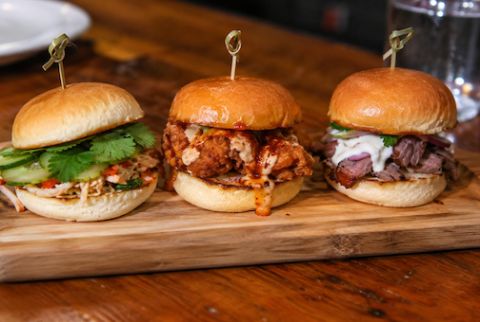
Sliders are a good example of how this works. The base format is familiar: small burgers or sandwiches in a 2 - 3-bite portion, easy to share and eat between turns. Giving sliders a global spin is not about a major change. It is about changing the flavor story. A banh mi chicken slider keeps the basic slider but adds pickled carrots and daikon, cilantro, and chili mayo to evoke Vietnamese street food. A hot honey sambal chicken slider uses sambal and honey to deliver a Southeast Asian - influenced sweet heat on a familiar fried chicken base. A shawarma lamb slider uses spiced ground lamb, garlic sauce, and pickles on a mini bun to bring Middle Eastern flavors into a game-playing-friendly form. In each case, the guest instantly understands what to do with the item (it's still a slider), but the flavor profile is noticeably more interesting than a plain cheeseburger slider. Flatbreads, tacos, wraps, and other foods can be treated the same way.
Beverages follow the same logic. Industry trends point to yuzu, tamarind, hibiscus, guava, lychee, rose, matcha, and sweet-spicy (swicy) profiles as key growth areas in cocktails and premium drinks. A practical recommendation is to have roughly 30% to 40% of cocktails and signature nonalcoholic drinks feature global flavors. That might look like a yuzu paloma instead of a standard paloma, a tamarind-chili margarita instead of a basic margarita, and a chili-mango mule instead of a plain Moscow mule. Again, the basic composition is familiar; the global flavor twist is what feels new.
The nonalcoholic strategy should mirror the cocktail side. Reports on 2026 beverage behavior show that younger adults are drinking less alcohol and actively seeking sophisticated zero-proof options. The strongest approach is to create true mocktails that match the flavor profiles of the cocktails, such as a zero paloma with yuzu and grapefruit, a no-jito yuzu cooler, or a mango mule zero, so guests can zebra‑strip between alcoholic and nonalcoholic drinks without changing their flavor experience. Adding NA lagers, IPAs, pilsners, hop waters, and ciders rounds out the drink menu for guests who prefer beer-like options without alcohol.
The key to a global menu approach is balance. A social eatertainment venue need not brand itself as a global restaurant to benefit from these trends. Instead, the goal is to build a broad‑appeal, game‑play‑friendly menu and drink program, then use global flavors and credible nonalcoholic options to make it feel current, distinctive, and inclusive for today's younger adult guests.
Subscribe to monthly Leisure eNewsletter
Vol. XXVI, No. 6, June 2026
- Editor's corner
- A barbell approach to the K-shaped economy
- Alcohol use among teenagers is on the decline
- The number of community location-based entertainment venues continues to grow
- Our company's latest social eatertainment project opens
- The importance of global flavors for social eatertainment venues
- Is your LBE venue seeing real revenue growth?