

Vol. XXVI, No. 6, June 2026
- Editor's corner
- A barbell approach to the K-shaped economy
- Alcohol use among teenagers is on the decline
- The number of community location-based entertainment venues continues to grow
- Our company's latest social eatertainment project opens
- The importance of global flavors for social eatertainment venues
- Is your LBE venue seeing real revenue growth?
A barbell approach to the K-shaped economy
In last month's article on the K-shaped economy, we wrote that location-based entertainment centers (LBEs), including FECs, cannot win by trying to be all things to all people with a middle-of-the-road offering. Success now comes from understanding the K-shaped economy and targeting upper-middle- and higher-income families as the primary market, with adult-oriented, experience-driven venues that appeal to these households, featuring elevated design, good lighting, attractions that facilitate socialization, strong food and beverage in an environment equivalent to a nice casual dining restaurant, not just a concession, and premium, reservable experiences.
To attract upper-middle- and higher-income guests, LBEs need to be premium venues. That can include reservable bowling lanes, social darts bays, golf simulators, immersive game rooms, private event spaces, upgraded lounge seating, and superior service. These guests are not simply buying game time; they are buying convenience, status, comfort, and a night out that feels worth the time and money. Premium F&B matters here too: elevated comfort food, craft cocktails, better beer and wine, and polished presentation all reinforce that the LBE is an experience rather than a cheap amusement stop.
In the current K-shaped U.S. economy, higher-income households continue to command a larger share of wealth and consumer spending, while many middle-income households face tighter discretionary budgets and heightened anxiety about unexpected costs. For LBEs and FECs, this means middle-income guests increasingly need a clear answer to one question: “What will this outing cost me?”
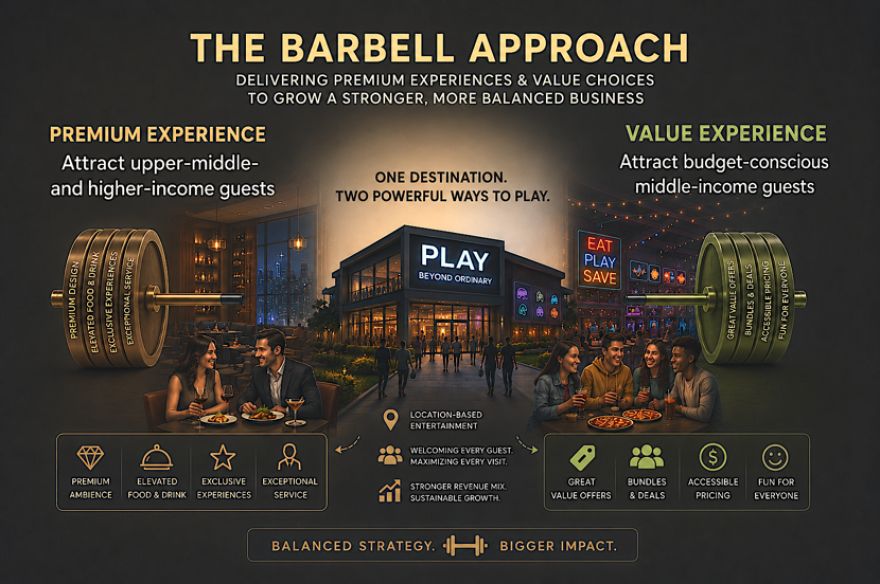
There is a strategy to capture top-income households in the K-shaped economy while also reaching some of the middle market. It is a barbell approach, with elevated design, offerings, and hospitality at one end and transparent, budget-friendly packaging at the other.
But the barbell only works if the middle feels financially comfortable entering the building. That requires value offerings that make spending predictable. Timed play packages are among the clearest tools. Topgolf, for example, promotes gameplay “from as low as $20 per hour” and has rolled out half-off weekday golf, weekend late-night pricing, Sunday family offers, and a seasonal pass that provides two hours of play during designated off-peak windows for one player plus up to five guests. These offers reduce price anxiety because guests know the play period and their maximum spending, with savings tied to lower-demand times. Similar logic works in community LBEs: one hour of duckpin for up to six guests, two hours of social darts with a food credit, or a weekday early-evening package with a fixed bay rental and no surprise add-ons.
Bundled attractions are equally powerful because they turn a confusing, unpredictable à la carte visit into a simple, budget-friendly outing. Main Event packages illustrate this model: combinations of one hour of bowling, a game card, one or more secondary attractions, pizza, and a soft drink, all bundled at a stated per-guest price. Birthday packages, ranging from about $16 to $30 per guest, combine activities, arcade credits, food, and host service into a single decision for families. The lesson for LBEs and FECs is straightforward. Instead of forcing guests to calculate bowling, arcade, laser tag, and food separately, sell “2 hours, 3 activities, entrée, and drink” as a single offer.
Approachable food options also ease spending anxiety for the middle market. The goal is not cheap food but recognizable, satisfying food at price points people understand. Topgolf's “Funday Faves Platter,” priced to feed up to six, is a useful example: pretzel bites, mac bites, chicken sliders, chips, salsa, and queso in a single, clearly priced, shareable item. This approach works better for value-conscious guests than forcing everyone into individual entrées. LBEs and FECs can extend this idea with platter menus, combo meals, pizza or flatbread bundles, kids' meal packages, and nonalcoholic drink bundles, alongside premium add-ons for higher spenders.
The most resilient LBEs and FECs are built on dual logic: premium enough to capture the rising share of spending controlled by upper-middle- and high-income households, yet flexible and value-structured enough to remain accessible to middle-income guests. In a K-shaped economy, the venues that thrive are not those that design and price everything in the middle to serve everyone the same way, but those that deliberately serve different income customer groups with distinct value propositions under one coherent brand. They are the ones that make premium irresistible and value easy to understand.
Subscribe to monthly Leisure eNewsletter
Vol. XXVI, No. 6, June 2026
- Editor's corner
- A barbell approach to the K-shaped economy
- Alcohol use among teenagers is on the decline
- The number of community location-based entertainment venues continues to grow
- Our company's latest social eatertainment project opens
- The importance of global flavors for social eatertainment venues
- Is your LBE venue seeing real revenue growth?