


Vol. XXVI, No. 8, August 2026
- Editor's corner
- Are you chasing the wrong market?
- Lucky Strike's comparable same-store sales
- Competitive advantage has changed for location-based entertainment.
- Nonalcoholic beverages are now a mainstream category
- Why designing successful location-based entertainment venues has never been more complex
- The Party Hero; turning LBE birthday parties into unforgettable experiences
- Time spent at arts and entertainment venues still down from pre-pandemic
- Audits of existing location-based entertainment venues
- The digital detox movement
The digital detox movement
Young adults are quietly driving a digital detox movement, stepping back from constant connectivity in favor of real‑world, in‑person connection. Social eatertainment and competitive socializing venues are well positioned to capitalize on this shift.
Recent surveys show that a majority of Gen Z and younger millennials are trying to cut back on social media or screen time. A 2025 New Year's resolution survey of 1,000 U.S. adults found that more than half of Gen Z (52%) said they attempted to quit or significantly reduce their use of social platforms in 2025, primarily for mental health reasons. They are not abandoning the internet, but they are actively experimenting with app breaks, screen-time limits, fewer notifications, and “phone-light” days to combat anxiety, comparison fatigue, and sleep disruption. At the same time, 2026 reporting highlights a “quiet revolution” among young people who are swapping late-night scrolling for lunch dates, vinyl listening, and other tactile, offline pursuits.
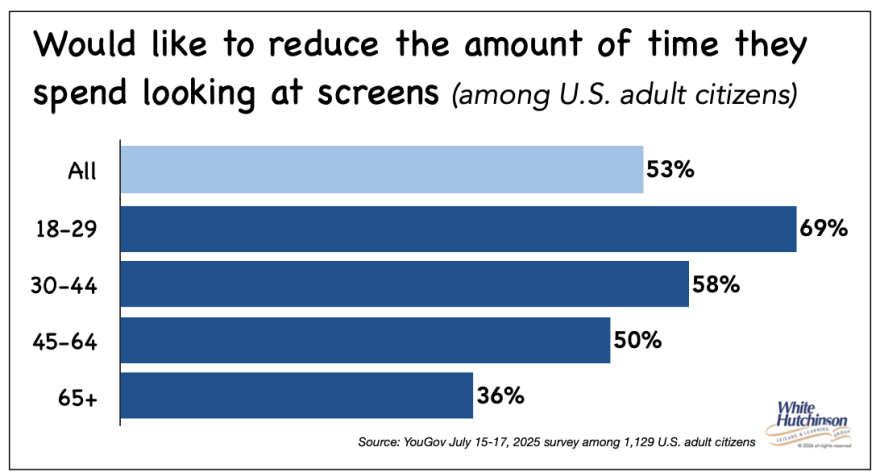
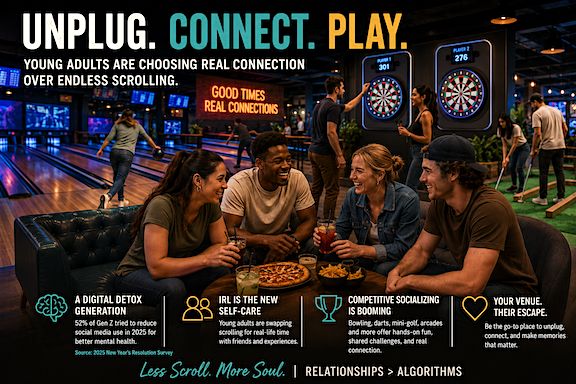
This desire to unplug dovetails with a renewed appetite for IRL social experiences. Young adults increasingly view in-person time with friends as self-care and a counterweight to digital overload, favoring structured, social, and memorable activities. Social eatertainment and competitive socializing have surged since 2021 because they offer hands-on play, shared challenges, social eating and drinking, and conversation-friendly environments that feel more meaningful than another night on the couch or a loud bar.
For LBE operators, this convergence of digital detox and IRL hunger is a clear opportunity. By positioning themselves as safe, structured spaces to unplug together, social eatertainment and competitive socializing venues can become the default choice for young adults who don't just want a night out; rather they want a brief, shared social escape from the endless scroll.
Subscribe to monthly Leisure eNewsletter
Vol. XXVI, No. 8, August 2026
- Editor's corner
- Are you chasing the wrong market?
- Lucky Strike's comparable same-store sales
- Competitive advantage has changed for location-based entertainment.
- Nonalcoholic beverages are now a mainstream category
- Why designing successful location-based entertainment venues has never been more complex
- The Party Hero; turning LBE birthday parties into unforgettable experiences
- Time spent at arts and entertainment venues still down from pre-pandemic
- Audits of existing location-based entertainment venues
- The digital detox movement