


Vol. IV, No. 3, March 2026
- Editor's corner
- Mash-Up Events for Agritourism Farms and Ranches in 2026
- 2026 is the International Year of the Woman Farmer
- Does your farm have liability insurance coverage for E. coli disease?
- Births fell again in 2025
- Increasing the length-of-stay increases parking requirements
- Taking the grilled cheese sandwich to an epic level
- Designing kitchens to reduce long lines
Births fell again in 2025
There has been a nearly two-decade-long decline in the nation's birthrate. The birthrate, the number of live births in a given year, is down more than 25% since its peak in 2007. In 2025, just over 3.6 million babies were born, fewer than in 2024.
If the birth rate had stayed constant at the 2007 rate, there would have been 696,000 more babies born in 2025. And since 2007, there would be over 8.0 million more children.
When our company conducts trade area analysis for agritourism farms, we are not only seeing a declining number of current children, but also a projected decline in the future. This includes suburban areas where you typically find higher concentrations of families with children.
As a result of this trend, the number of households with younger children is declining. For agritourism events such as fall festivals with corn mazes and pumpkin patches, the primary family attending brings children ages approximately 12 and younger. In 2025, there were nearly 7.0 million fewer children 12 and younger than in 2007. That age group is projected to continue declining and represent a smaller percentage of all households.
Here's a breakdown of the 2025 decline in the current number of children by age since 2007. For all ages, there are 8.1 million fewer children than if the 2007 birthrate had remained constant. For example, there are 695,000 fewer 5-year-olds and 444,000 less 8-year-olds.
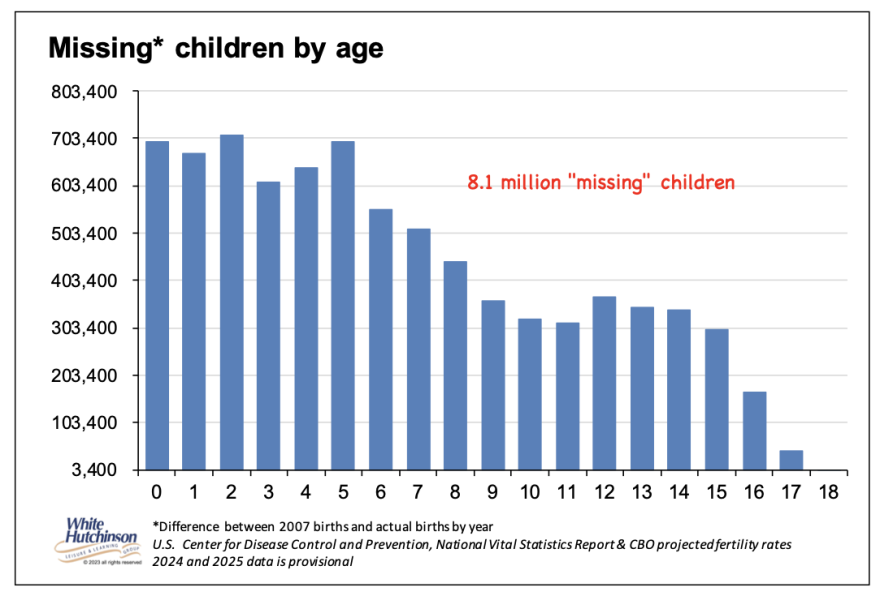
Not only has the number of children continued to decline, but the percentage of all households with children has also declined to only one-quarter of all households (25.5%).
This means that not only has the number of children been on the decline, but the share with children as well, and both are projected to continue to decline in the future. Agritourism farms need to consider what implications this has on their future if they are currently exclusively targeting families with children.
Subscribe to Agritourism Today
Vol. IV, No. 3, March 2026
- Editor's corner
- Mash-Up Events for Agritourism Farms and Ranches in 2026
- 2026 is the International Year of the Woman Farmer
- Does your farm have liability insurance coverage for E. coli disease?
- Births fell again in 2025
- Increasing the length-of-stay increases parking requirements
- Taking the grilled cheese sandwich to an epic level
- Designing kitchens to reduce long lines