


Vol. III, No. 2, February 2025
Gude for designing and operating safe animal petting zoo areas
For 30 years we've been helping agritourism farms with layouts, designs, and operations. Over those three decades of working with existing agritourism farms, we've never visited a farm that didn't need to improve the safety of their animal petting zoos. We hope this article can help our readers ensure their animal areas are safe for the public.
Animals are an endless source of wonder for children. There are few attractions that have a greater appeal to young children than animals. Research shows that young children feel a natural kinship with and are implicitly drawn to animals, especially baby animals. Children interact instinctively and naturally with animals, talk to them, and invest in them emotionally. Studies show that as many as 80% of the dreams of children younger than 6 are about animals. Additional evidence of animals' importance to children is that animals constitute more than 90% of the characters in children's preschool books. That is why animals and animal petting areas, often called petting zoos, are so popular at agritourism farms as they are a magnet for young children who bring their parents with them.
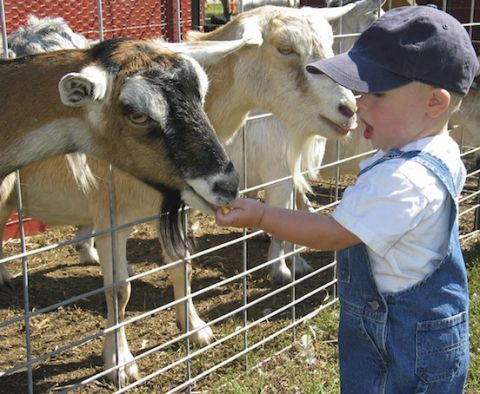
Farm animals that children can interact with - feed, pet, and groom - can be the foundation and main attraction for agritourism facilities that target families with children. The truth is adults also enjoy watching and interacting with animals. Unfortunately, animals can also pose serious risks to children in the form of injury and illness if the animal area is not correctly designed, managed, and maintained.
Preventing physical injury from animals that interact with children can be addressed by selecting appropriate and more docile breeds, using younger animals, proper design and fencing, and providing appropriate supervision.
However, what poses the most significant risk to agritourism visitors and the very economic survival of agritourism businesses is not the animals themselves. It's the microscopic organisms that animals can harbor, especially Escherichia coli 0157:H7, better known as E. coli 0157:H7 or just E. coli 0157. Outbreaks of E. coli 0157 can result in dire consequences for the farm's owner, as parents can boycott the facility, liability insurance can become very expensive or unobtainable, and the agritourism farm could go out of business. Furthermore, every outbreak increases parents' fears and reluctance to visit agritourism facilities with animals, hurting the entire industry. Even one outbreak hurts the industry as a whole.
Most often, it's infants and young children who become ill due to their underdeveloped immune systems and poorer hygienic practices compared with adults, such as more frequent hand-to-mouth behaviors. However, illnesses are preventable if the petting areas are correctly designed and managed.
E. coli 0157 causes human illness through the toxins that it produces that destroy the intestinal wall. The illnesses range from mild cases of acute diarrhea to death. Most infections are mild and don't require medical care. Acute illness from E. coli 0157 includes abdominal cramps, vomiting, diarrhea (often bloody), and sometimes fever. However, some cases can result in hemorrhagic colitis (bloody colon inflammation). In addition, a small percentage of cases (approximately 8% of all E. coli 0157 infections) develop hemolytic uremic syndrome (HUS), a life-threatening disease characterized by red blood cell destruction, kidney failure, and neurological complications, such as seizures and strokes. People who develop chronic kidney failure may require lifelong dialysis or a kidney transplant. Children under five years old who have not yet fully developed their immunities are especially susceptible to both E. coli 0157 and the development of HUS, which is the leading cause of kidney failure in children in the U.S. Of children affected with HUS, 3% to 5% will die. As many as 30% will have lifelong medical problems.
Symptoms of E. coli 0157 exposure develop within 5 to 9 days of exposure, and people infected usually recover in 5 to 10 days. The Centers for Disease Control (CDC) reports that about 200 people a day get ill from E. coli 0157, and a little over an average of one person a week dies from the illness. Only about one-tenth of one percent of all E. coli 0157 infections occur in animal petting areas. However, since the vast majority of illnesses occur in very young children, outbreaks receive wide press coverage and, as a result, heighten parents' fears of visiting animal petting areas.
Although the most significant number of E. coli 0157 illnesses are attributed to food contamination, studies by the CDC show the highest risk (probability of being infected) is from exposure to farm animals, especially cattle.

Cattle pose the highest risk of infecting agritourism visitors with E. coli
0157.
Other ruminants like sheep and deer can also carry the organism. Even dogs, chickens, goats, and pigs have been found to harbor E. coli 0157. E. coli 0157 is excreted in the manure or feces and can survive for long periods of time on the ground or the hides of animals. Anything that comes into contact with cattle manure can be contaminated, including ponds, lakes, streams, and groundwater by field runoff.
Research shows that E. coli 0157 can live for months in animal bedding and soil. E. coli 0157 infections have been traced to manure dust in areas where cattle had been removed 10 days earlier. Contamination from airborne dust was implicated in an Oregon county fair outbreak that sickened 60 people, primarily children, none of whom had touched animals.
Up to 50% of cattle can be contaminated, with the highest rates occurring in the summer. Complicating matters is that infected animals show no symptoms and do not become ill. Furthermore, farm residents have a much lower risk of infection than non-farm residents, probably because they acquire immunity to the illness due to their childhood and frequent exposure to the organisms. Therefore, there is no way to know that animals are infected, especially on farms where farm residents and workers rarely become infected.
The most recent child death from E. coli 0157 related to an animal petting area occurred in Rutherford County, TN in 2022, when a 2-year-old died. The Tennessee Department of Health said the child's older brother attended summer camp at Lucky Ladd Farms, where he picked up E. coli. 0157. The bacteria were then transmitted to the 2-year-old, who developed hemolytic uremic syndrome and died. The TDH also found that two other children who attended the summer camp got ill. The source of E. coli 0157 was traced to two baby goats in contact with the confirmed cases.
From 2000 through 2023, there have been at least 51 incidences of visitors getting sick from E. coli 0157 at petting zoos and animal petting areas in North America, with 1,137 children and adults getting ill, with over 198 being hospitalized and at least six deaths.
The primary mode of transmission of pathogenic E. coli is the fecal-oral route. Since animal fur, hair, skin, and saliva can become contaminated with fecal E. coli 0157, transmission can occur when persons pet, touch, or are licked by animals. Most children's illnesses are caused by hand-to-mouth transfer of E. coli 0157 after touching or being licked by animals. Young children will pet a sheep, goat, or calf, touch a contaminated surface, sit or fall on contaminated ground, and then put their fingers into their mouths or touch the food they're going to eat.
Other ways this transfer can occur are by:
- Eating and drinking or bringing food and beverages into the petting area.
- Bringing a stroller into the petting area (getting manure on the wheels).
- Picking items, like pet food, off of the ground.
- Touching surfaces such as handrails and benches in the petting area.
- Stepping on manure or getting manure on your shoes.
- Sucking thumbs, biting nails, touching one's face, or sucking a pacifier in the animal area.
- Drying hands on one's (contaminated) clothes.
Research by the CDC and state agriculture departments of E. coli 0157 outbreaks at animal petting areas attribute illness almost entirely to some form of hand-to-mouth (or food/pacifier-to mouth) transfer.

The single most important preventative measure guests can take is handwashing. Research has found that people who washed their hands after visiting the petting zoo, including lathering with soap and then rewashing them before eating, escaped illness. Not having calves, cows, or other ruminant animals and young poultry in petting areas also significantly reduces risk.
Animal petting area operators can significantly reduce the risk of E. coli 0157 or other animal-transmitted pathogenic illnesses through the physical design and management of their facilities:
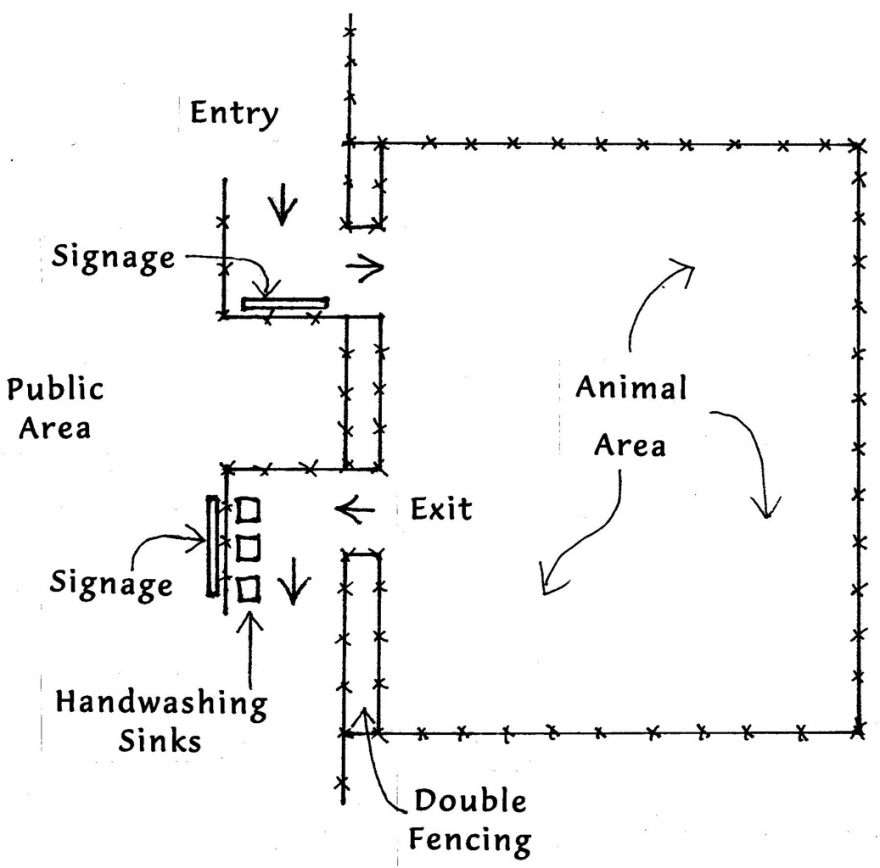
- Animal contact areas should be designed to be separated by some distance, fenced, and gated from play and eating areas. This includes double-fencing in areas where guests could touch animals from outside the designated animal area.
- Materials used to construct animal areas and pens visitors can come in contact with should be non-porous, such as metal rather than wood, allowing more effective sanitization. Railings and fences visitors can contact should be cleaned and disinfected regularly.
- There should be entry and exit transition areas. The entry area should include signage about the risk of contact with animals and educational information on the heightened risk for children five and younger, people with a high risk of infection or reduced immunity, and persons who are cognitively impaired or pregnant. Information should tell parents how to minimize risk to their children, including not allowing children to put their fingers in their mouths. Food, beverages, smoking, carry toys, strollers (so the wheels won't have E. coli picked up from the ground to outside the animal area and possibly home), pacifiers, spill-proof cups ("sippy cups"), or baby bottles should not be permitted in the animal areas. The sign should be positioned to face people as they enter the animal area so it can't be missed.
- Have a clearly marked designated area near the entrance for visitors to leave strollers and related items (e.g., wagons, diaper bags, toys, pacifiers, and baby bottles).
- The exit area should have adequate handwashing sinks (including ones low enough at 22" for easy use by children) with running water, liquid soap dispensers, and disposable paper towel dispensers within reach of each sink. Clear signage should instruct all guests to wash their hands and for parents to assist their children with handwashing. The handwashing stations and signage should be positioned straight out of the exit gate so exiting people face it and it can't be missed (see diagram). Handwashing signs should be readable at a distance, use bulleted text and graphics illustrating handwashing, and be multilingual if possible. Hand sanitizers are not considered an acceptable alternative to handwashing at animal areas.
- Ensure enough handwashing sinks are available for the expected number of visitors during anticipated peak attendance. If lines at handwashing stations are long, visitors may not wash their hands or may wash quickly to keep the line moving.
- Schedule staff to monitor the handwashing station to encourage all visitors to wash their hands when leaving and ensure that soap and paper towels are always available.



- Limit the maximum number of visitors allowed in the petting area at crowded times. When the petting area is crowded, visitors are less likely to see handwashing signs and handwashing stations or are less likely to wait in line to wash their hands.
- Animals should be kept clean, and hay, urine, soiled bedding, and uneaten food should be removed regularly. Manure should be removed on a timely basis. If it becomes dry, subsequent air movement can result in the airborne spread of manure dust, which could spread infectious E. coli 0157 onto surfaces and into public areas.
- In the animal areas, animal feed and water, shovels, pitchforks, and other tools to remove animal bedding should not be accessible to the public.
- If feeding animals is permitted, only food sold at the venue for that purpose should be allowed. Animal food should not be sold in ice cream cones that children might eat.
- Animals that are not safe for children to interact with should be double-fenced. A slanted feed tube can be put in the fence to allow people to drop feed into it.
- The Americans with Disabilities Act (ADA) requires animal petting areas to be accessible to people with disabilities. This means there must be accessible paths (walkways that people in wheelchairs can traverse). So, unlike strollers, which can be restricted from animal areas, wheelchairs and other mobility assistance devices cannot. Have a place where wheelchairs and mobility devices can be sanitized after leaving the animal area. Procedures should be established for staff to assist people with sanitizing any parts of the devices that come in contact with animals or the ground upon exiting the animal area.
- Animal areas should be supervised by staff trained on how to minimize risk and intervene with children and parents whose children are not following safe practices.
- Animals should be monitored daily for signs of illness and ensure that animals receive appropriate veterinary care. Ill animals, animals known to be infected with a zoonotic pathogen, and animals from herds with a recent history of diarrhea or respiratory disease should not be exhibited. To decrease the shedding of pathogens, animals should be housed in a manner to minimize stress and overcrowding.
- Food and beverage areas should be separated, distant, and uphill (to prevent contamination by groundwater runoff) from animal areas and have additional clearly visible outdoor handwashing facilities available.
- Pony ride areas should also follow the above standards.
- Farm ponds that the public can access should not be located where animals can access them or where water can become contaminated by runoff from fields or other areas that contain animals or animals visiting the pond.
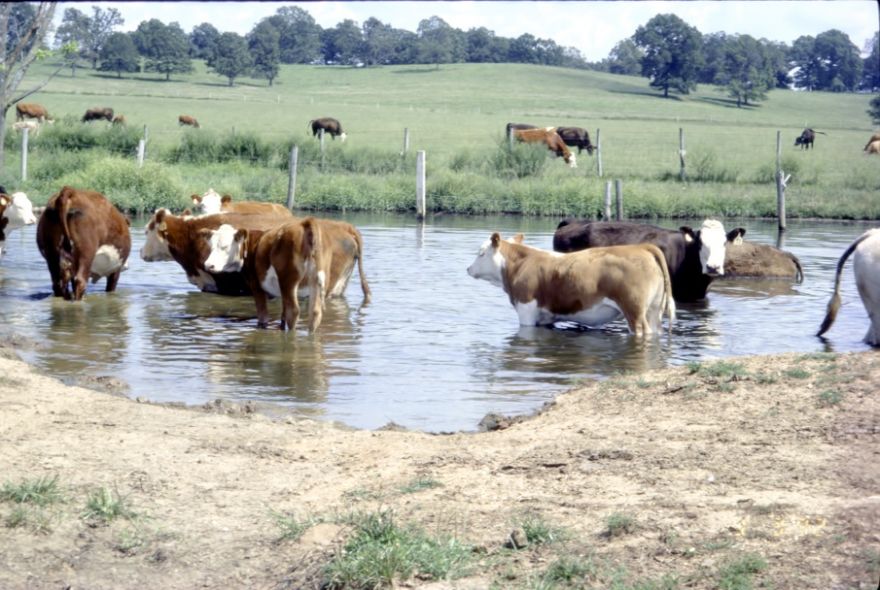
E. coli 0157 can be spread by pasture water runoff into ponds & streams.
- Agritourism farms that offer animal contact should:
- Post information on their websites about the risks of animal contact and include educational material for parents on how to minimize risks when visiting.
- Post signs with similar information at the entry to the facility.
- Offer a handout parent guide upon entry to their facility on how to enjoy the facility and adequately supervise their children's interaction with animals. This handout can include other information for parents about how their family can best enjoy their stay at the farm, a map of the facility, perhaps a farm history, and additional helpful information.
- For school groups, supply the schools with information about the risk of infection when interacting with animals and the importance of handwashing to go home with permission slips. Have staff review safety measures with students and chaperons before they exit the bus or enter the animal petting area.
Farm animals are a powerful magnet to children and a key to the success of many agritourism facilities that target families with children. With a properly designed facility, correct operating procedures, well-trained staff, and informed visitors, children can be offered the opportunity to enjoy and interact with farm animals with minimal risk. Doing it right is the best insurance policy for an agritourism facility's long-term success.
Additional resources and information:
- Sample sign at the entrance to the animal area
- Sample sign at the exit of the animal area
- Sample sign at the handwashing station
- Downloadable PDFs of many types of signs for animal petting areas
- National Association of State Public Health Veterinarians' Compendium of Measures to Prevent Disease Associated the Animals in Public Settings
- Safeagritourism.org has a whole series of checklists covering petting zoos and things like hayrides, corn mazes, inflatables, play areas, petting zoos, etc. They also offer walkthroughs with photos and questions followed by explaining the correct answer.
Subscribe to Agritourism Today