


Vol. IV, No. 10, October 2026
- Editor's corner
- Your fall season is a research lab: 12 numbers to capture before it ends
- Why referrals matter more than ever in agritourism
- It's not too late to review the safety of your hayrides
- Master planning is more than a site plan
- Beyond pumpkin spice: How agritourism can capitalize on fall's expanding flavor palette
Master planning is more than a site plan
When we work with farms to plan an expansion or a new agritourism venture, they expect a master plan drawing showing where the buildings, parking, and attractions will go. However, the master plan should be the result of the planning process. A good master plan translates a business strategy into a business that can operate well and grow over time.
Our first step is to determine whom the farm should serve and what it should offer. That program gives the site plan its direction, while the farm's physical limits help refine it.
Start with the market
We begin by examining the farm's realistic trade area: the competing experiences people can choose, the residents who live within it, and the visitors already coming to the area. This research helps us identify demand and the white space that existing venues do not serve well. It also prevents us from assuming that a popular attraction elsewhere will succeed on this farm.
In totally undeveloped markets, new agritourism farms can simply imitate what other farms are doing, especially fall corn mazes and pumpkin patches. However, in many markets, in fact, most markets, families already have several choices for corn mazes, pumpkin patches, fall festivals, and sunflower events. A farm that copies those offerings needs a clear reason for guests to choose it over the competition. The opportunity may be a fall experience with a different appeal that serves an underserved audience, or an offering in another season. The point is to build the program around a real market opportunity, not around a list of familiar attractions.
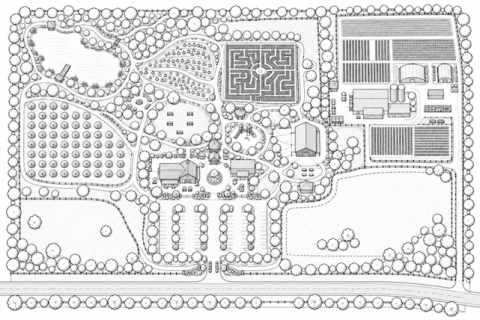
The program must also fit the property and the working farm. Guest arrival, parking, utilities, staffing, and space for farm operations can constrain capacity and affect the design. Applicable zoning, permits, and other regulations are reviewed early, before the program is finalized.
Only after the program is finalized do we begin designing the master plan.
Build in stages
A useful master plan identifies what to build first and what can wait. Early investment should support the initial program without constraining future growth. Roads, utilities, and circulation should be appropriate for the opening phase and allow room for future growth. As the business learns from attendance, revenue, and guest feedback, later phases can be refined before construction begins.
The finished master plan drawing is the outcome of several decisions: whom the farm will serve, what will make the visit worth choosing, and how the operation will run. When those questions are answered first, the master plan becomes a realistic guide for investment and growth.
For more on the physical planning challenges, read Designing for what comes next: Why agritourism master planning is more complex than ever.
Subscribe to Agritourism Today
Vol. IV, No. 10, October 2026
- Editor's corner
- Your fall season is a research lab: 12 numbers to capture before it ends
- Why referrals matter more than ever in agritourism
- It's not too late to review the safety of your hayrides
- Master planning is more than a site plan
- Beyond pumpkin spice: How agritourism can capitalize on fall's expanding flavor palette