

Vol. IV, No. 11, November 2026
- Editor's corner
- Rhode Island farmer sets world record with 3,156-pound pumpkin
- Let state fair foods inspire your farm's next signature treat
- There are now more than 1,300 corn mazes. Is there room for yours?
- Military research yields more strawberries and an earlier harvest
- Three types of agritourism customers and how to attract them
- Beware of using AI for feasibility
- Programming creates occasions to visit
- Food experiences can bring new customers to your farm
There are now more than 1,300 corn mazes. Is there room for yours?
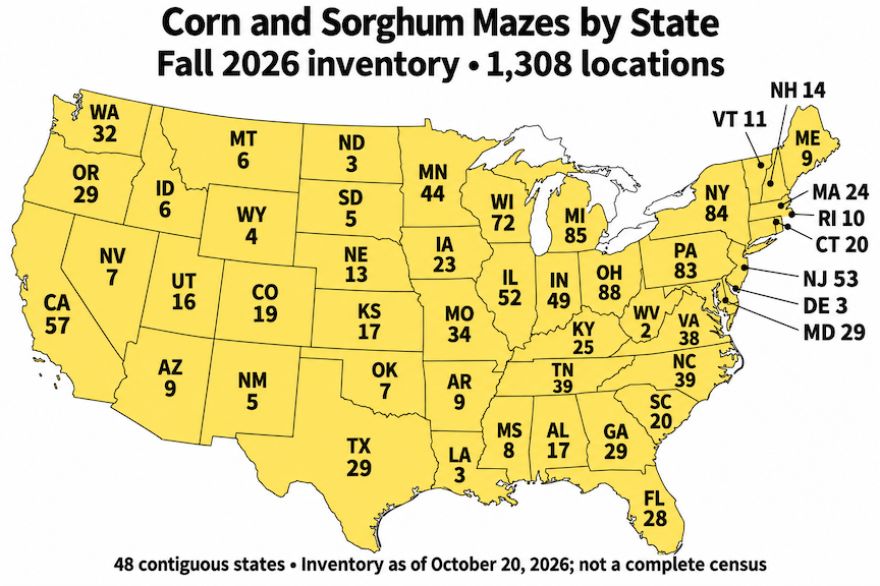
Corn mazes have evolved from an unusual attraction to a familiar part of the North American fall landscape. Our company's detailed inventory for fall 2026 identified 1,308 locations with corn or sorghum mazes across the lower 48 contiguous states. That includes 88 in Ohio, 85 in Michigan, and 72 in Wisconsin. Those numbers may surprise operators who remember when a corn maze alone was enough to distinguish their farm from nearby farms.
The modern corn maze business began in 1993 with the Amazing Maize Maze at Lebanon Valley College in Annville, Pennsylvania. Designed by Adrian Fisher and produced by Don Frantz, the maze featured “Cornelius the Cobasaurus.” It covered 3.3 acres, contained about 1.92 miles of pathways, and charged admission to support Midwest flood relief. That inventive fundraiser helped establish a business model that soon spread nationwide.
In 2006, the Associated Press reported more than 500 corn mazes nationwide. In 2015, Smithsonian reported more than 800. Our 2026 inventory now includes more than 1,300 locations offering corn or sorghum mazes. PickingFarms currently lists only 847 farms in its corn maze directory. Our inventory is about 54% larger.
Our count is not a 100% complete census. Additional locations may qualify, but for a number we could not verify their crop material, current operations, or other details. We believe there may be at least 100 more mazes than we verified.
When a successful attraction becomes commonplace
The spread of corn mazes shows how readily the idea adapted to different farms and markets. Widespread adoption also diminishes the competitive value of having one. When a farm is the only one nearby offering a maze, the attraction gives consumers a clear reason to visit. When several farms within an easy drive offer mazes, simply advertising the maze alongside other activities becomes less persuasive. A maze can still be enjoyable while simultaneously becoming less effective at distinguishing one agritourism farm from another. That is the commercial risk of commoditization. Guests have more substitutes, and operators must work harder to justify their prices.
Free mazes devalue the admission price of a farm with a maze. In 2026, Diehl's Orchard & Cider Mill in Holly, Michigan, and several other orchards advertise their corn mazes as free. An orchard can use a free maze to attract customers who buy cider, donuts, apples, and pumpkins. A free orchard maze has different financial requirements than a large fall festival, which requires substantial staffing, advertising, and infrastructure. For a nearby business that charges admission, that free attraction becomes part of the customer's comparison. A paid maze can still compete, but the overall experience must justify the admission price.
What population is needed to support a maze?
Our state population comparisons found substantial differences in supply relative to population. Wisconsin, with 72 mazes, has about 83,000 residents per maze; Michigan, with 85 mazes, has about 119,000; and Ohio, with 88 mazes, has about 135,000. Vermont's ratio is only 59,000 residents per maze. These figures raise serious questions about competitiveness.
State averages also obscure local conditions. A farm near a state line may attract customers from a neighboring state. A state with relatively few mazes, like Idaho, with 338,000 people for each of its 6 mazes, may still have several competing for the same metropolitan population.
What matters is the number of potential customers within a realistic drive time, the competing destinations serving them, and the spending those customers can generate.
For startups, feasibility has become essential
For new agritourism businesses considering a fall festival with a maze, competition has made a market feasibility study essential. The familiar fall festival formula can look attractive when established farms appear busy. But their success does not prove the market has room for yet another operator. Existing businesses may already capture much of the available demand, benefit from years of customer loyalty, and have grown to a size a startup cannot match.
Our company's recent work illustrates that risk. For the last three farm startups we conducted market feasibility studies for, we found that their markets were too saturated with competition to support another fall festival with a maze. We advised all three to pursue other agritourism white-space opportunities we identified in their markets, including agritourism experiences with unmet demand and less direct competition. Those findings changed the development direction before the owners committed to facilities and attractions in an overcrowded market.
A feasibility study should identify the customer base, evaluate competing farms and their pricing, and determine whether achievable attendance and spending levels can support the proposed business. It should also explore agritourism opportunities beyond the owner's original concept.
Existing operators need the same discipline when expanding. A larger maze or a more elaborate aerial design may attract publicity but not enough additional revenue to justify the investment. Better food, improved guest comfort, or programming for an underserved audience may offer greater potential.
The growth of corn and sorghum mazes has reshaped opportunities for new entrants. With more than 1,300 locations, the familiar formula warrants careful scrutiny. Before investing in another fall festival featuring a maze, determine whether the market can support it and whether a different agritourism concept offers a stronger opportunity.
Subscribe to Agritourism Today
Vol. IV, No. 11, November 2026
- Editor's corner
- Rhode Island farmer sets world record with 3,156-pound pumpkin
- Let state fair foods inspire your farm's next signature treat
- There are now more than 1,300 corn mazes. Is there room for yours?
- Military research yields more strawberries and an earlier harvest
- Three types of agritourism customers and how to attract them
- Beware of using AI for feasibility
- Programming creates occasions to visit
- Food experiences can bring new customers to your farm