


Vol. IV, No. 6, May 2026
Is it time to reinvent and rebrand your farm's agritourism?
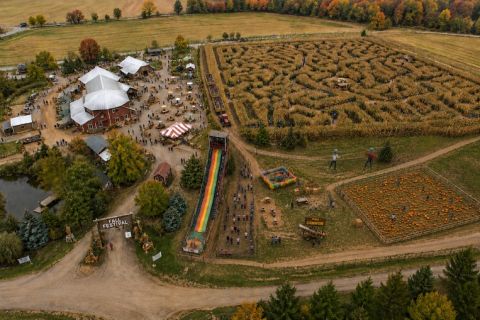
There is no definitive date for when agritourism, as we know it today, began. U-pick has existed for a very long time. The first recorded modern corn maze used as a ticketed agritourism attraction was The Amazing Maize Maze in Annville, Pennsylvania, developed in 1993 by Don Frantz and Adrian Fisher. Most historians point to that as the origin of the corn-maze fall-attraction model. There is no clear national record of which farm first branded the combined experience as a “fall festival with a corn maze.” Many farms added corn mazes to existing pumpkin patches or harvest events through the late 1990s and early 2000s, and those efforts evolved into the fall festival with corn-maze model we know today. Over the years, more and more farms have started fall festivals. It is estimated that about 800 farms in North America now have fall corn mazes.
Annual sunflower festivals began appearing at U.S. farms in the late 2000s and 2010s. Like fall festivals, they have increasingly been added to farms' annual calendars.
Over the years, more and more farms added corn mazes and then followed by adding sunflower festivals, to the point where many markets are now mature, oversaturated, and overly competitive.
Here's a breakdown of the number of fall corn mazes in the most competitive Metropolitan Statistical Areas (MSAs) with populations of 1.0 million or more, showing the highest number of mazes, along with the market population per festival.
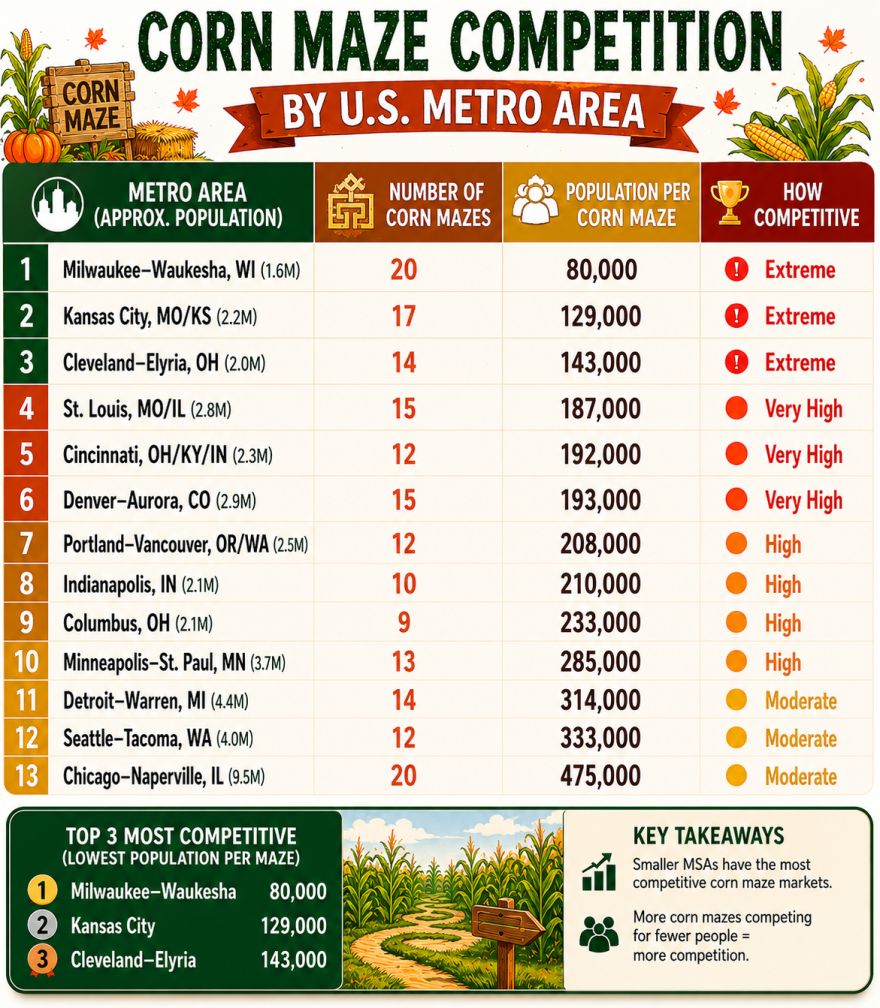
The Chicago MSA has the most corn mazes but is still moderately competitive when measured by people per maze. Milwaukee-Waukesha, Kansas City, and Cleveland are the most competitive metro areas, with fewer than 150,000 population per corn maze.
In addition to our MSA analysis, there are areas of the country with a high density of corn mazes, such as the Orange County-Hudson Valley area of New York.
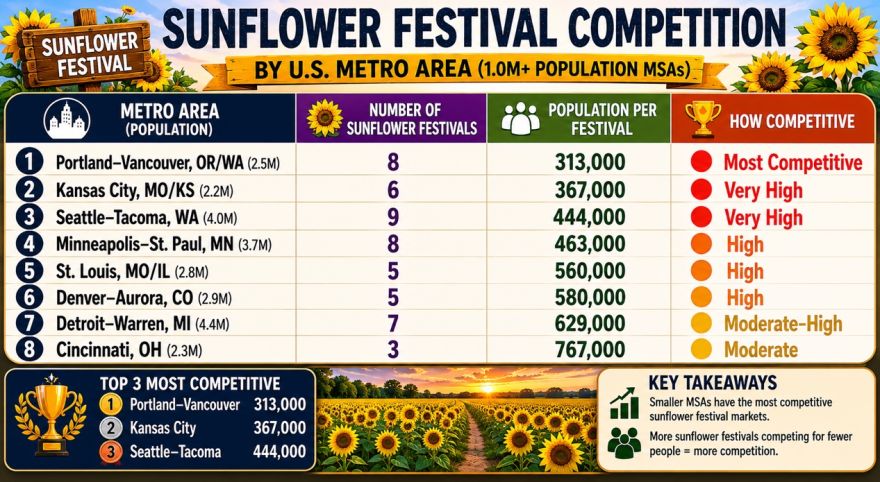
MSAs with sunflower festivals are less saturated than those with corn mazes. However, our company's annual agritourism participation surveys show that sunflower festivals have a 35% lower participation rate than fall festivals with corn mazes. This means they require a larger population per festival than corn mazes do.
The most competitive MSAs for sunflower festivals are Portland-Vancouver, OR/WA, and Kansas City, MO/KS with fewer than 400,000 people per festival.
We are receiving reports from some farms that they are seeing a decline in both sunflower and fall festival attendance. In the most competitive markets, we believe that when a farm starts a new fall or sunflower festival, it initially draws strong attendance due to its novelty and people checking it out as a new option. But over a few years, the more established, typically larger festivals attract more and more of the available attendance, and the newer festivals see a decline.
Data from TicketSpice shows that the 50 largest fall-festival farms by pre-purchased ticket sales saw an average 22% increase in ticket sales in 2025, while the next 50 by sales only saw 3% growth, indicating that larger festivals, more likely the older ones, are gaining market share at the expense of newer, smaller festivals.
Another problem in oversaturated markets is that festivals become commodities, and all festivals lose their pricing power for admission.
Our company was recently retained by a farm in one of these competitive markets that was experiencing declining attendance at both its fall and sunflower festivals. The basic problem was that several other agritourism farms in the metro, the older, more established ones, offered more.
Agritourism is a diverse industry with many options beyond fall and sunflower festivals. We analyzed that farm's competition, as well as the demographics and socioeconomics of the farm's primary trade area, to identify market white spaces that could be tapped. We found that almost all the competition was the same, leaving wide openings to attract a different demographic and socioeconomic group that was not being addressed to any extent, as well as opportunities for new events with minimal competition. The farm is keeping its sunflowers, but they will no longer be the focus of a festival. Instead, they will serve as the backdrop for a new, more food-forward festival. The fall festival is also being repositioned to a different target market group, with a new name and activities. We also recommended adding transformational events and some new Friday evening events.
We just finished worked with a 2nd farm in another oversaturated market, helping them shift their offerings and events away from direct competition with the many other agritourism farms in their area
In competitive markets throughout North America, agritourism farms need to diversify both their target markets and their offerings rather than simply imitating what other farms offer to be successful and grow their businesses.
Subscribe to Agritourism Today