
This is a print-friendly version of www.whitehutchinson.com/news/lenews/2026/august/article106.shtml

[ Index of Previous eNewsletters (www.whitehutchinson.com/ news/ lenews/ previous.shtml) ]
Not that long ago, designing a successful location-based entertainment venue was relatively straightforward. Find a good trade area, add popular attractions, provide enough parking, and the business had a good chance of succeeding. Those days are over.
Today's successful entertainment venues, from family entertainment centers (FECs) and competitive socializing to social eatertainment concepts, can no longer be designed around attractions alone. They must be designed around the guest experience. Attractions, food and beverage, social spaces, ambiance, programming, technology, operations, and financial performance must all work together as a single integrated system. The complexity has increased dramatically because consumers have more entertainment choices than ever before, including ones at home, and expectations have never been higher.
Perhaps the biggest misconception among developers and investors is that the project begins with selecting attractions. In reality, attraction selection is a later planning decision, not the first step.
The process begins with understanding the market. Every successful LBE starts with a detailed analysis of its trade area. Population alone tells very little. Age distribution, household composition, income levels, education, employment sectors, psychographics, spending habits, and leisure lifestyles all influence what consumers are likely to support. A market dominated by young professionals has very different expectations than one dominated by families with children or by affluent empty nesters.
Socioeconomics matter just as much. Adult-focused social eatertainment concepts featuring on-trend food, craft cocktails and mocktails, and social games require a customer base willing and able to spend significantly more per visit than at traditional family entertainment centers. Conversely, markets with more value-conscious consumers may require an entirely different mix of attractions, pricing strategies, and food offerings.
Competitive analysis is equally critical because many developers mistakenly count only direct competitors. Today's competitors extend far beyond bowling centers, arcades, and miniature golf. Consumers choose among restaurants, breweries, wineries, festivals, concerts, sporting events, museums, escape rooms, pickleball clubs, and countless other leisure options. Even an outstanding entertainment center may struggle if it offers little that sets it apart from what already exists in the market.
Only after understanding the market and competition should concept development begin. The goal is to identify the white space and the combination of attractions, food and beverage, pricing, and overall experience that best aligns with opportunities and unmet demand in that market.
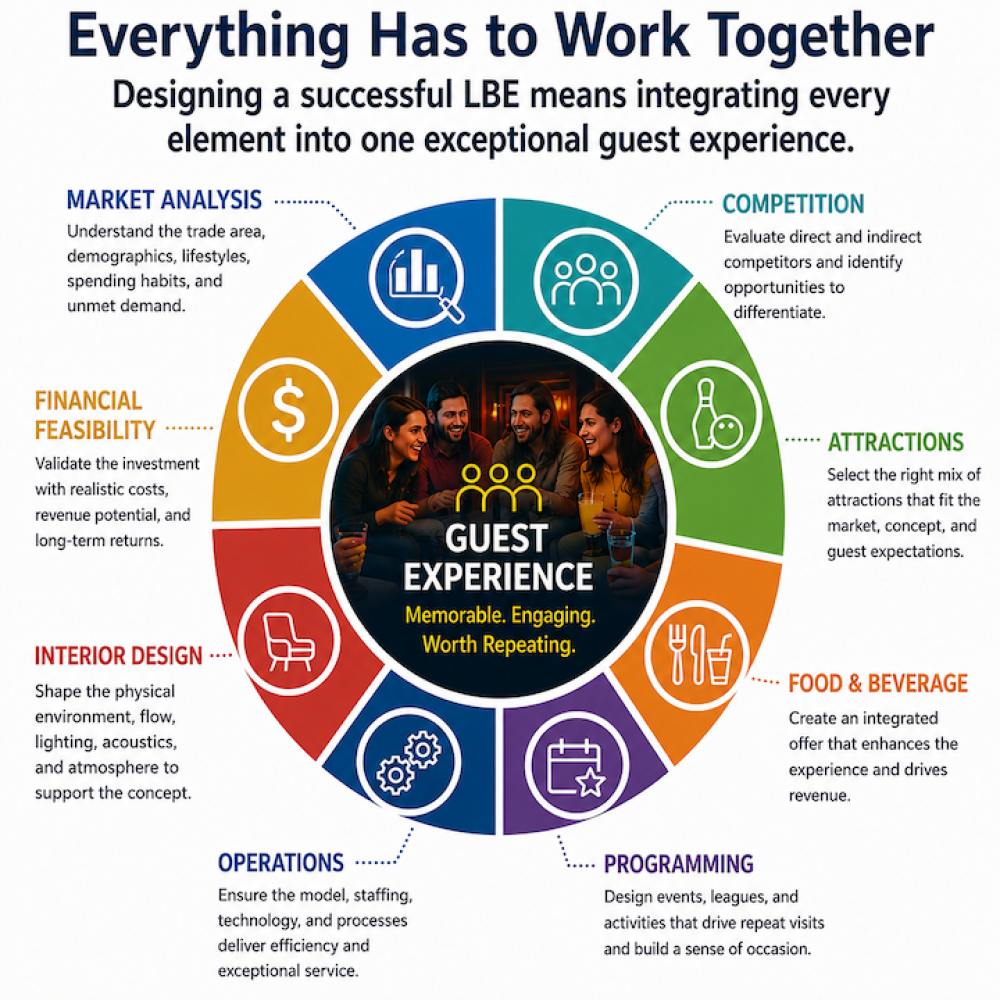
The question is no longer, "What attractions are popular?" Instead, it becomes, "Which combination of attractions best satisfies unmet demand in this specific market, and how should they be integrated with all other elements to deliver the desired experience?” That distinction fundamentally changes the entire design process.
A social eatertainment venue targeting younger adults might emphasize social games that encourage conversation, on-trend food and beverages, and comfortable seating. The same building designed for families with younger children would require completely different attractions, circulation patterns, food service, pricing, operating hours, and overall experience.
Food and beverage planning has become as important today as attraction planning. Twenty years ago, food was often an amenity, essentially just a concession. Today, it is frequently one of the primary reasons people choose one venue over another. Many consumers increasingly view restaurants as entertainment destinations, making menu selection and culinary quality essential components of the competitive equation rather than merely a supporting feature.
Designing the right food and beverage program requires balancing numerous variables. Who is the target customer? How long will they stay? What occasion are they celebrating? Which beverages appeal most to them? What type of service should be offered? In social eatertainment venues, food and beverages are consumed while guests are playing, rather than in a separate dining area. That means the menu, service model, seating, tables, drink rails, circulation, and kitchen operations all must support the gaming experience rather than interrupt it.
The menu itself affects kitchen size, equipment selection, staffing requirements, operating costs, and building utilities, and it also shapes the overall experience. A poor food and beverage strategy can undermine an otherwise excellent entertainment concept.
Space planning adds another layer of complexity. Entertainment venues must accommodate multiple activities occurring simultaneously. Guests need to move comfortably between attractions, bars, dining areas, lounges, party rooms, restrooms, and entrances without congestion. Proper sightlines encourage participation and energy while allowing parents to supervise children or adults to socialize. Noise management is especially important for social experiences.
More importantly, the physical design must reinforce the experience the venue aims to deliver. A social eatertainment venue designed to encourage conversation and connection requires a very different environment than one built around high-energy competition or family play. Seating arrangements, table spacing, lighting, acoustics, sightlines, attraction placement, and even ceiling heights influence whether guests primarily interact with each other or with the attractions. If the goal is socialization, the attractions should facilitate conversation rather than dominate it, and food, beverage, and lounge spaces should be integrated as equal components of the experience rather than as afterthoughts.
Programming adds yet another layer of complexity. Facilities need to be designed around occasions rather than attractions alone. Trivia nights, themed events, leagues, live entertainment, seasonal celebrations, corporate outings, and social gatherings all influence how spaces should be designed. Flexible environments that support changing programming typically outperform highly specialized facilities with limited adaptability.
Only after the concept, attraction mix, food and beverage program, operational model, and preliminary facility layout are developed, meaningful cost estimates and financial projections can be prepared. Sometimes the analysis confirms the concept. Other times, it reveals that the attraction mix, building size, or investment must be modified, or that the project is not financially viable. In practice, successful projects often go through several iterations to achieve the optimal balance of guest experience, operational efficiency, and financial performance.
Finally, perhaps the most difficult challenge is designing for tomorrow rather than just today. Entertainment preferences, food trends, drinking habits, and demographics shift. Technologies emerge. Consumer expectations continue to rise. Buildings costing millions of dollars must remain competitive for decades, not just during the excitement of their opening year, when everything tends to work.
One of the biggest mistakes developers make is looking to today's most successful venues for inspiration and simply copying them. By the time a concept that started development years earlier opens, consumer preferences may already be moving beyond it. Projects often take several years from concept to opening, and once built, they are expected to remain competitive for decades. Designing for yesterday's trends is a recipe for premature obsolescence.
Instead, successful projects begin by understanding the emerging demographic, lifestyle, leisure, technology, and consumer behavior trends that will shape future demand, not merely those driving today's market. Those trends should inform everything from attraction selection and kitchen and bar design to building layouts, operational flexibility, and expansion planning.
Designing with a future perspective requires more than studying competitors. It demands ongoing research into where consumers are headed rather than where they have already been. That future-focused discipline is what separates venues that remain successful for decades from those that begin to feel dated only a few years after opening.
For more than three decades, White Hutchinson has made identifying emerging consumer, demographic, and leisure trends before they become mainstream a core discipline in its planning, design, and development of clients' LBEs. That future-proofing perspective results in LBE venues designed not only for opening day but also for the marketplace they will operate in years down the road.
An attraction may be what first captures a guest's attention, but it is only one piece of a much more complex puzzle. Successful location-based entertainment venues result from carefully integrating market analysis, competitive positioning, the right attraction and food-and-beverage mix, thoughtful design, operational excellence, and memorable guest experiences into a cohesive concept. That is why designing a successful LBE has never been more complex and why getting the early planning decisions right has never been more important.
Subscribe to monthly Leisure eNewsletter (www.whitehutchinson.com/ subscribe/ lenews/ )
[ Index of Previous eNewsletters (www.whitehutchinson.com/ news/ lenews/ previous.shtml) ]
© 1999 - 2026, White Hutchinson Leisure & Learning Group, Inc.
The contents of this website and eNewsletters are protected by USA and international copyright law. Permission is granted to download and print single copites of any of the contents or articles for personal use. No other copies may be made. Educational institutions may obtain permission to make multiple copies for classroom use by e-mailing us with details. The contents of articles may be quoted provided credit is given to the "(author's name), White Hutchinson Leisure & Learning Group, Kansas City, MO, USA". All other rights for use or reproduction of the contents and articles are reserved.