
This is a print-friendly version of www.whitehutchinson.com/news/lenews/2024/november/article106.shtml

[ Index of Previous eNewsletters (www.whitehutchinson.com/ news/ lenews/ previous.shtml) ]
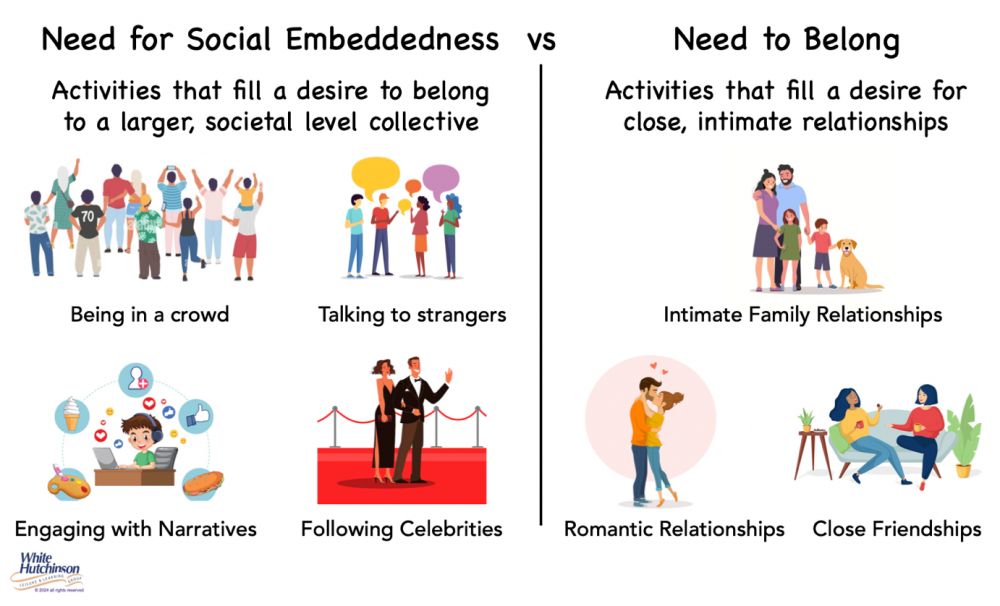
People have a strong desire to belong, often met through interpersonal relationships such as friendships and romantic partnerships. Still, an equally strong human motivation exists to have a place in broader society-and it's just as essential to well-being. It's what a University at Buffalo psychologist, Shira Gabriel, Ph.D calls "social embeddedness."
The need to belong and social embeddedness are both social connections, but their connections are made through different means. Gabriel says that social embeddedness is as important as the need to belong.
"There's a general understanding that we need other people to make us happy, but our desire to fit into the larger society is almost invisible to us because it usually operates without conscious awareness," says Gabriel.
From an evolutionary perspective, humans need to be socially embedded to survive. We evolved for social living, allowing for shared resources and increased protection from predators.
What allowed us to survive in the past is something that can help us thrive in the present: We feel good when we're socially embedded, according to Gabriel.
"There's a great deal we get from interacting with people in society who aren't close friends or relationship partners," says Gabriel. "Being in a crowd at a football game or concert makes us feel good because it reminds us that we are a part of a society of people."
People can also feel socially embedded through parasocial relationships, a one-sided connection with a celebrity or other public figure where the other person is unaware of the relationship. This can include an audience member engaging with celebrities, sports figures, or politicians.
"We found in our research that engaging in narratives, like binge-watching a television series, can make you feel like a member of the show's social network," says Gabriel. "You feel like you are connected to the characters, which fills the need to feel embedded.
"Understanding that we engage in these behaviors, which might seem illogical or selfish, allows us to be easier on ourselves," says Gabriel. "It's not hedonism or laziness. It's being human."
"People are happiest when their needs to belong and to be socially embedded are both met."
JLL's 2024 Global Consumer Experience Survey found that consumers seek experiences combining human-centric spaces that foster a strong sense of community, belonging, and connection - social embeddedness.
Social embeddedness is a significant factor in the appeal of concerts, sports events, and even attending a movie. It can also add to the appeal of theme parks and community location-based entertainment venues, including family entertainment centers, especially crowded ones. The need for social embeddedness also explains why venues of all types don't feel as appealing when they are not crowded, especially when they are almost empty.
Subscribe to monthly Leisure eNewsletter (www.whitehutchinson.com/ subscribe/ lenews/ )
[ Index of Previous eNewsletters (www.whitehutchinson.com/ news/ lenews/ previous.shtml) ]
© 1999 - 2026, White Hutchinson Leisure & Learning Group, Inc.
The contents of this website and eNewsletters are protected by USA and international copyright law. Permission is granted to download and print single copites of any of the contents or articles for personal use. No other copies may be made. Educational institutions may obtain permission to make multiple copies for classroom use by e-mailing us with details. The contents of articles may be quoted provided credit is given to the "(author's name), White Hutchinson Leisure & Learning Group, Kansas City, MO, USA". All other rights for use or reproduction of the contents and articles are reserved.