
This is a print-friendly version of www.whitehutchinson.com/news/lenews/2023/february/article107.shtml

[ Index of Previous eNewsletters (www.whitehutchinson.com/ news/ lenews/ previous.shtml) ]
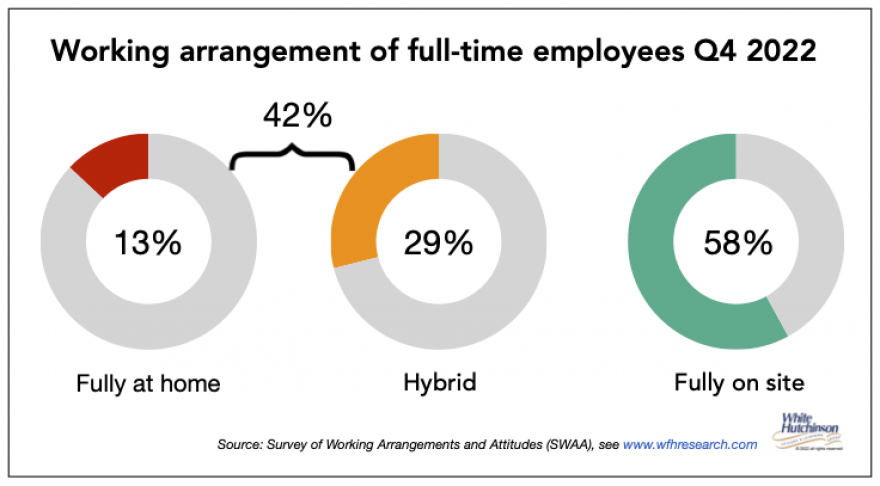
The COVID-19 pandemic has dramatically changed the way Americans spend their time. One of the most enduring shifts has occurred in the workplace, with millions of employees switching to work from home. Even as the pandemic has waned, 13 percent of full-time employees remain fully remote, and an additional 29 percent work in hybrid arrangements.
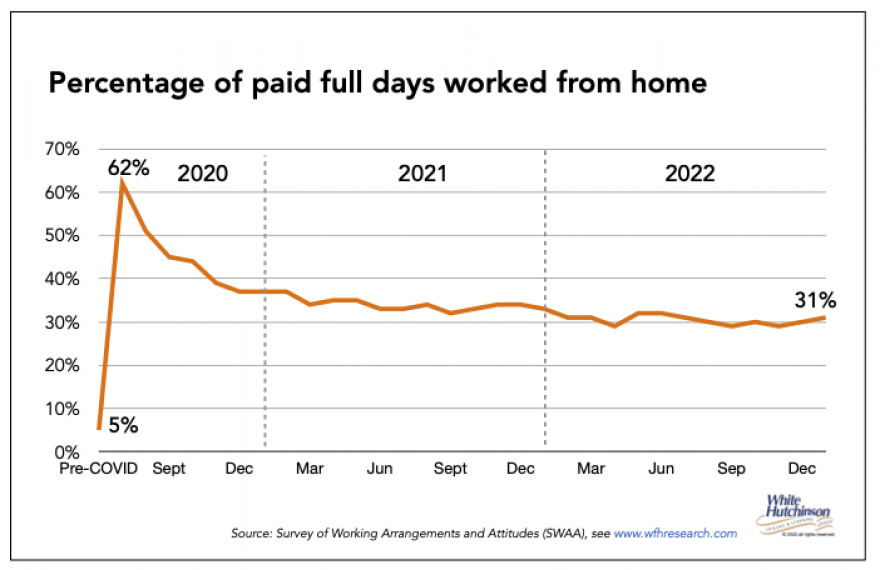
As a result, 30% of paid full days worked are now done from home.
It has also resulted in reduced office occupancies. January 25, 2023 average office occupancy level in 10 large metro areas with the highest occupancy rates was only 50.4% of the prepandemic level.
Working full or part-time (hybrid work) at home resulted in reduced time commuting to work by an average of 4.8 hours per week. Americans now spend 60 million fewer hours traveling to work each day. A research paper* by the Federal Reserve Bank of New York examined how people spend that saved time on other activities.
The research found notable increases in leisure time and sleeping. The rise in leisure was particularly pronounced among younger Americans, who reported spending more time at social events, eating at restaurants or bars, and exercising. On the other hand, older age groups tended to allocate more time to nonmarket work, such as childcare, household maintenance, repairs, and meal preparation.
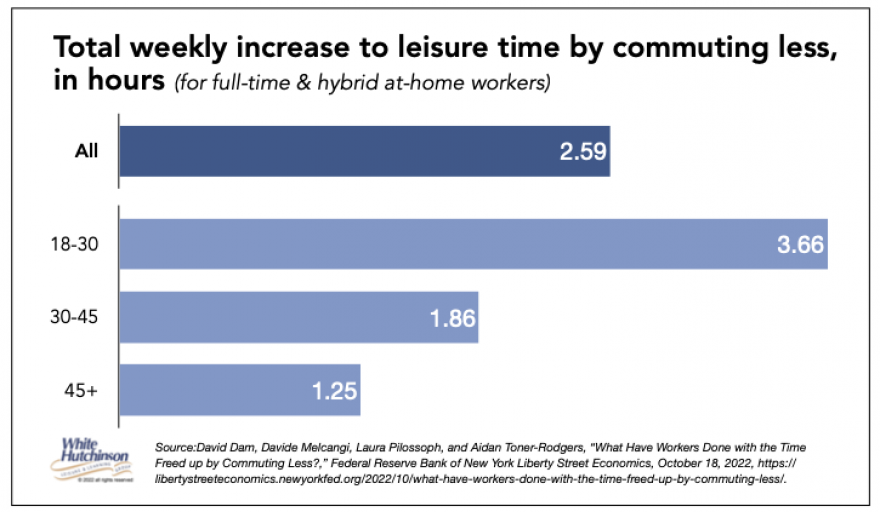
For all age groups, some of the saved commuting time was spent sleeping, 1.2 more hours per week. There was an even greater increase in leisure time, +2.6 hours for all adults. The 18-30 age group saw the most significant increase of 3.7 hours more leisure time per week.
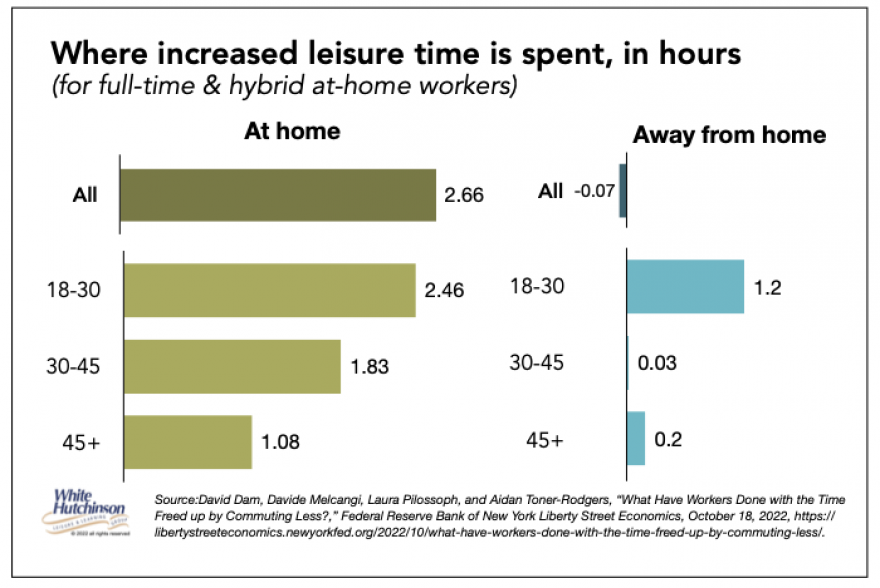
Almost all the increase in leisure time was spent at home. Only the 18-30 age group spent some of their saved commuting time on leisure away from home, +1.2 hours per week.
The research also looked at whether the increase in leisure time was spent with household members or with non-household members. It was only the aged 18-30 who spent a significant amount of their increased leisure time with non-household members, 31%, a little over one hour per week.
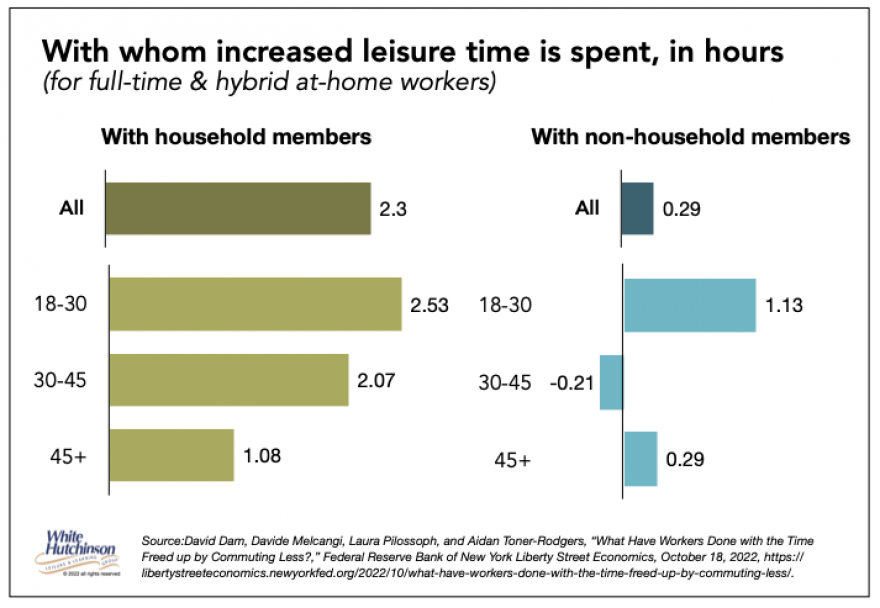
The research did not examine whether for the 18- to 30-year-olds, that time with non-household members was spent at home or away from home.
18- to 30-year-olds are the most targeted age group for many location-based entertainment venues. Full-time at-home and hybrid workers in the early Gen Z-later millennial age group now have more leisure time, around 3.7 hours per week, with about one-third of it already being spent away from home. With compelling offerings, location-based entertainment venues might be able to capture some of the away-from-home leisure time and even get younger adults away from their at-home screens and other activities where they are currently spending the balance of their leisure time gained by commuting less.
* David Dam, Davide Melcangi, Laura Pilossoph, and Aidan Toner-Rodgers, "What Have Workers Done with the Time Freed up by Commuting Less?," Federal Reserve Bank of New York Liberty Street Economics, October 18, 2022,
[ Index of Previous eNewsletters (www.whitehutchinson.com/ news/ lenews/ previous.shtml) ]
© 1999 - 2026, White Hutchinson Leisure & Learning Group, Inc.
The contents of this website and eNewsletters are protected by USA and international copyright law. Permission is granted to download and print single copites of any of the contents or articles for personal use. No other copies may be made. Educational institutions may obtain permission to make multiple copies for classroom use by e-mailing us with details. The contents of articles may be quoted provided credit is given to the "(author's name), White Hutchinson Leisure & Learning Group, Kansas City, MO, USA". All other rights for use or reproduction of the contents and articles are reserved.