
This is a print-friendly version of www.whitehutchinson.com/news/lenews/2018/august/article103.shtml

[ Index of Previous eNewsletters (www.whitehutchinson.com/ news/ lenews/ previous.shtml) ]
We've been reporting over the past few years on the what is referred to as the “Baby Bust,” the continuing decline in the number of births. In our May-June issue article, Where have all the babies gone (www.whitehutchinson.com/ news/ lenews/ 2018/ june/ article109.shtml#article) , we reported that 2017 saw the lowest number babies born since 1987. Then in our July article, Why American's are having fewer babies (www.whitehutchinson.com/ news/ lenews/ 2018/ july/ article103.shtml#article) , we reported on the results from a survey of adults ages 20 to 45 on why they are having fewer babies.
The results on births are now available for the first quarter of 2018, and the fertility rate (number of births per 1,000 women age 15 to 44) has hit a new low of 60.1 compared to the low of 60.2 in 2017.
A July 2018 Center for Retirement Research report, Is the drop in fertility temporary or permanent? (crr.bc.edu/ briefs/ is-the-drop-in-fertility-temporary-or-permanent/ ) , analyzed whether the decline is a lingering effect of the Great Recession or a structural shift in childbearing in the U.S. The report concludes that the decline is permanent rather than a temporary result of the Great Recession. It found four structural changes that strongly suggest it is a permanent decline that will continue:
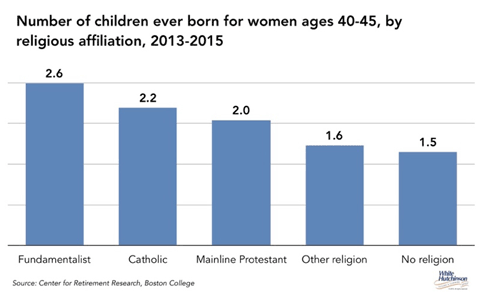
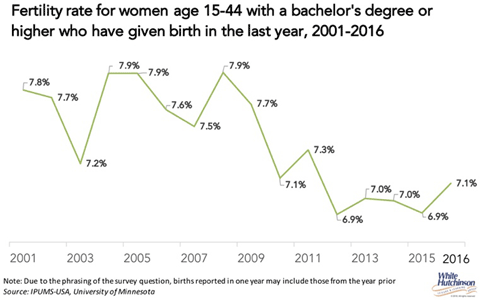
One contributing factor to the declining birthrate among college-educated women is they are delaying childbirth to their later childbearing years.
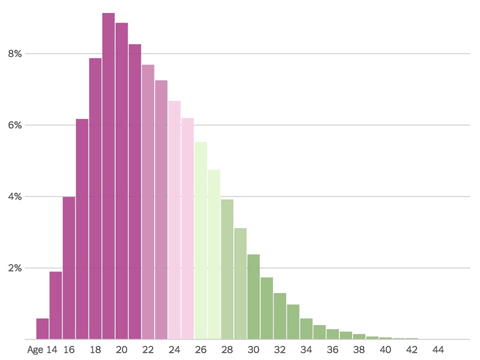
The New York Times' Upshot (www.nytimes.com/ section/ upshot) recently ran an article The Age that Women Have Babies/How a Gap Divides Americans (www.nytimes.com/ interactive/ 2018/ 08/ 04/ upshot/ up-birth-age-gap.html) , that is well worth a read. In the article they had two graphs illustrating how dramatically the age of first births has shifted over time.
 |
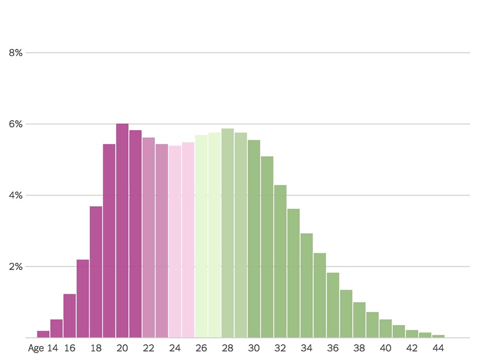 |
| Ages of first-time mothers in 1980 | Ages of first-time mothers in 2016 |
Their analysis of birth data found that women with college degrees have children an average of seven years later than those without. Heather Rackin, a sociologist at Louisiana State University who studies fertility, said “People with a higher socioeconomic status just have more potential things they could do instead of being a parent, like going to college or grad school and having a fulfilling career.”
The average age for first-time mothers in the U.S. is now 26. The oldest first-time mothers are found in San Francisco County, CA, where the overall average age is 31.9 and for college+ women, 33.4.
If you are interested in learning the average age of first birth overall for married women and for college+ women in any county in the U.S., that UpShot article (www.nytimes.com/ interactive/ 2018/ 08/ 04/ upshot/ up-birth-age-gap.html) allows you to look up that data.
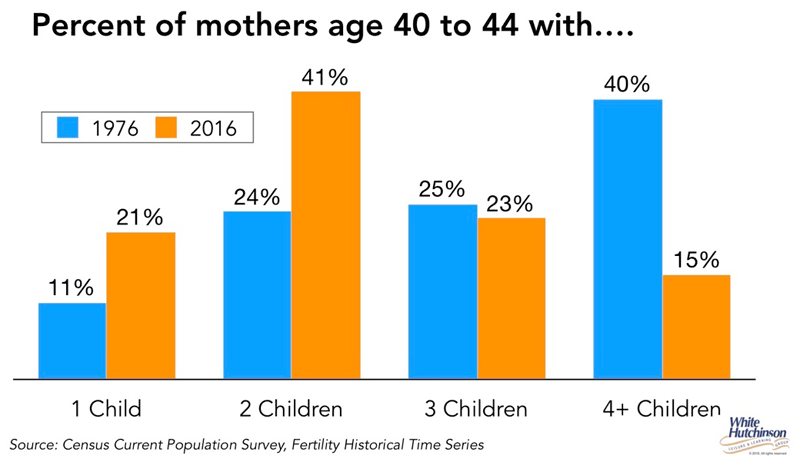
One result of the declining birth rate is that middle children have become rarer. In 2016, almost 2/3rds of mothers only had two or less children, whereas 40 years ago, 2/3rds had three or more children.
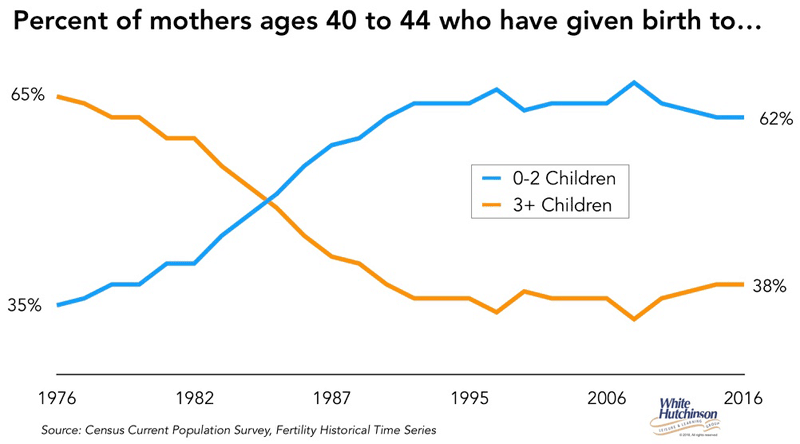
Far more mothers now only have two children and fewer have four or more children.
Of course, the bad news for community leisure venues that target children, including FECs and children's entertainment and edutainment centers, is the continuing decline in the number of new babies, and thus a future decline in the number of potential children as customers.
The good news is the when women finally have children, especially the college-educated ones, those women generally have higher incomes than in decades past and therefor can afford to take their children to CLVs.
[ Index of Previous eNewsletters (www.whitehutchinson.com/ news/ lenews/ previous.shtml) ]
© 1999 - 2026, White Hutchinson Leisure & Learning Group, Inc.
The contents of this website and eNewsletters are protected by USA and international copyright law. Permission is granted to download and print single copites of any of the contents or articles for personal use. No other copies may be made. Educational institutions may obtain permission to make multiple copies for classroom use by e-mailing us with details. The contents of articles may be quoted provided credit is given to the "(author's name), White Hutchinson Leisure & Learning Group, Kansas City, MO, USA". All other rights for use or reproduction of the contents and articles are reserved.