
This is a print-friendly version of www.whitehutchinson.com/news/lenews/2016/january/article107.shtml

[ Index of Previous eNewsletters (www.whitehutchinson.com/ news/ lenews/ previous.shtml) ]
The Puget Sound project in the this issue's article (www.whitehutchinson.com/ news/ lenews/ 2016/ january/ article103.shtml) will be very socially responsible. What is known as Corporate Social Responsibility (CSR), often also referred to as “corporate citizenship,” is a company's initiatives to assess and take responsibility for the company's effects on the environment and social wellbeing and includes such practices as charitable giving, fighting discrimination and sexism, fair labor practices, Fair Trade, animal welfare and of course green environmental practices.
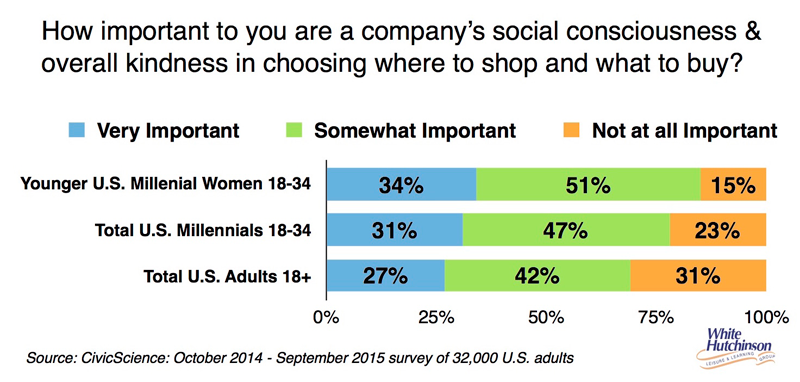
CSR has become a very important aspect of consumers' decisions for what companies they choose to do business with. Over a one-year period ending in September 2015, CivicScience asked about 32,000 U.S. adults how important a company's social consciousness and overall kindness are to them when they choose where to shop and what to buy. Almost 7 in 10 (69%) said it was either “very” or “somewhat” important, with over one-quarter (27%) saying it was very important. Women rated it to have the higher importance than men.
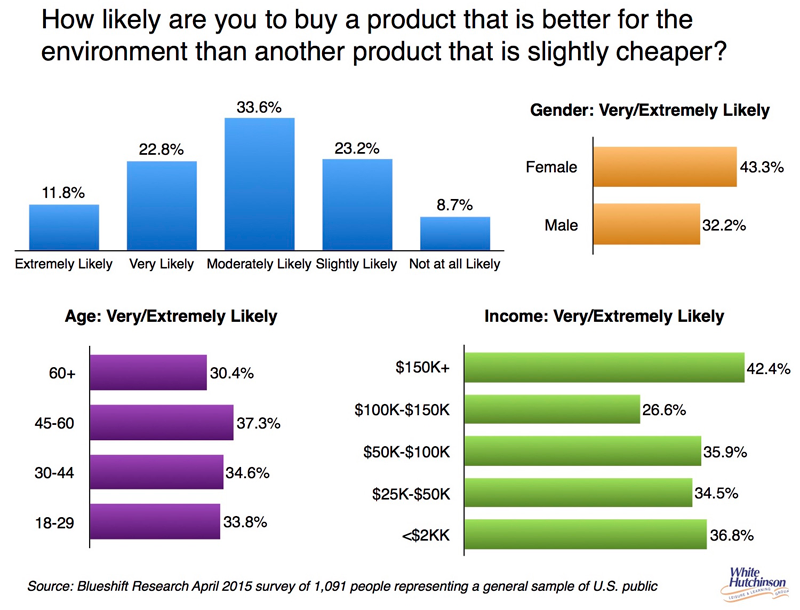
A survey by Blueshift Research earlier in 2015 found that many consumers are willing to pay a premium price for a green product. Over one-third (35%) said they were very/extremely likely to do so. Women, households with income of $150,000+ and adults age 45 to 60 were more very/extremely likely to do so than average.
A Nielsen worldwide survey of 30,000 consumers in early 2015 found similar results. Nearly two-thirds (66%) of respondents said they're willing to pay more for products and services that come from companies that are committed to positive social and environmental impact, up from 55% in 2014, and 50% in 2013. In terms of specific company attributes, 58% said they were willing to pay more if a product is from a company known for being environmentally friendly and 56% said they were willing to pay more if the product is from a company known for its commitment to social value.
And lastly for the surveys, the 2015 Cone Communications/Ebiquity Global CSR study found that 90% of consumers would switch to a brand if it supported a cause.
Today, people want to have good experiences with companies that do good. A company's values and the story behind its brand are now as important as the goods, services or experiences it sells. For the most part, with the exception of our Puget Sound client and a few projects that you can probably count on the fingers of one hand, the location-based entertainment industry, including FECs, is far behind the curve on practicing the values that are becoming increasingly important to consumers and that are now influencing which companies they choose to do business with by voting with their dollars.
In addition to doing good for society and the planet, CSR can be a significant competitive advantage in today's highly competitive out-of-home leisure landscape.
[ Index of Previous eNewsletters (www.whitehutchinson.com/ news/ lenews/ previous.shtml) ]
© 1999 - 2026, White Hutchinson Leisure & Learning Group, Inc.
The contents of this website and eNewsletters are protected by USA and international copyright law. Permission is granted to download and print single copites of any of the contents or articles for personal use. No other copies may be made. Educational institutions may obtain permission to make multiple copies for classroom use by e-mailing us with details. The contents of articles may be quoted provided credit is given to the "(author's name), White Hutchinson Leisure & Learning Group, Kansas City, MO, USA". All other rights for use or reproduction of the contents and articles are reserved.