
This is a print-friendly version of www.whitehutchinson.com/news/lenews/2007/august/article109.shtml

[ Index of Previous eNewsletters (www.whitehutchinson.com/ news/ lenews/ previous.shtml) ]
Where do Americans splurge the most - exotic vacations, nights out on the town, luxury cars, fancy camps and schools for their kids? And if they were forced to tighten the belt, where would they choose to reduce their spending? If your business includes food and/or entertainment, this article is a must-read.
A nationally representative telephone survey in late 2006 by the Pew Research Center looked at Americans' saving and spending habits. One thing researchers examined was whether certain luxuries have morphed into necessities. It nicknamed this activity 'splurging.'
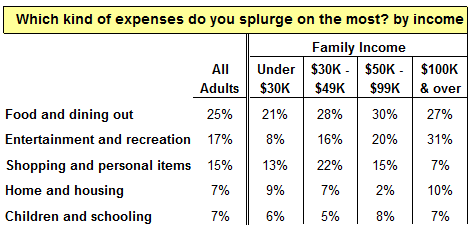
The top five areas where respondents admitted they spent too much, or splurged:
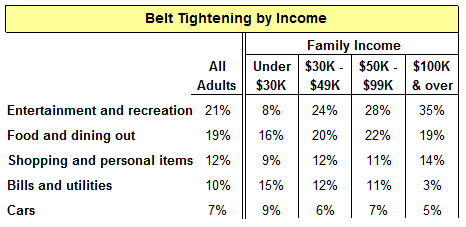
The respondents were then asked, "If you needed to cut back, which expenses would you cut back on?" Note how consumers changed the order:
Not surprisingly, the rate of splurging and the activities on which people indicated they'd belt-tighten varied by family income. Families with higher incomes, and thus, high discretionary incomes (see story, Discretionary incomes (www.whitehutchinson.com/ news/ lenews/ 2007/ august/ article104.shtml#article) ), splurged more often on entertainment and recreation than lower-income families.
Findings from the Pew study are generally consistent with a June 2007 survey of 1,004 consumers by the International Council of Shopping Centers (www.icsc.org/ rsrch/ research.php) (ICSC) that examined what impact, in any, higher gasoline prices had on spending during the previous month. The ICSC study found about 60% of respondents reported reducing the frequency of their shopping due to higher fuel expenditures, but not reducing their discretionary spending over the previous month on such items as clothing, shoes, jewelry, consumer electronics, beauty services or non-essential items.
For consumers who scaled back discretionary spending, the ICSC study found dining out was the expense most likely to be cut. Slightly more than a quarter (26%) of households reduced their restaurant expenditures, followed by approximately another quarter (23%) that scaled back on travel. Entertainment spending was the third most cited area of reduction (12%), followed by spending on clothing and shoes (11%).
When it came to belt-tightening, a larger percentage of higher-income families would cut back on entertainment and recreation, compared to lower-income families.
 Researches who study behavior say that American's spend-happy habits -- or splurging on things that make them feel happy -- often beyond their incomes, is part of America's cultural DNA and dates all the way back to 1775. T.H. Breen, author of The Marketplace of Revolution: How Consumer Politics Shaped American Independence (www.amazon.com/ gp/ product/ 019518131X/ qid=1040080502/ sr=1-1/ ref=sr_1_1/ 102-4383808-2899341?s=books \&v=glance \&n=283155) , Amazon associates link says, "If you want to understand how important our consumer market is to us, just look at the various protests against taxation that led to the American Revolution."
In his book, he reported, "People [during that time] purchased the items they most desired... (and) often demanded and received liberal credit... The colonists' shared experience as consumers provided them with the resources needed to develop a bold new form of political protest." According to Breen, consumer goods provided the essential and "powerful link between everyday life and political mobilization."
So splurging helped create the United States. Luckily, splurging on entertainment and restaurants ranks high in today's world.
[ Index of Previous eNewsletters (www.whitehutchinson.com/ news/ lenews/ previous.shtml) ]
© 1999 - 2026, White Hutchinson Leisure & Learning Group, Inc.
The contents of this website and eNewsletters are protected by USA and international copyright law. Permission is granted to download and print single copites of any of the contents or articles for personal use. No other copies may be made. Educational institutions may obtain permission to make multiple copies for classroom use by e-mailing us with details. The contents of articles may be quoted provided credit is given to the "(author's name), White Hutchinson Leisure & Learning Group, Kansas City, MO, USA". All other rights for use or reproduction of the contents and articles are reserved.