This is a print-friendly version of www.whitehutchinson.com/news/learnenews/2004/04/article102.shtml

White Hutchinson Leisure & Learning Group, Kansas City, MO, USA
Vol. III, No. 4, April 2004
- What Makes Space Work? (www.whitehutchinson.com/ news/ learnenews/ 2004/ 04/ article101.shtml#article)
- What Makes Outdoor Sand Play Work? (www.whitehutchinson.com/ news/ learnenews/ 2004/ 04/ article102.shtml#article)
- Wiring Could Pose Lead Risk (www.whitehutchinson.com/ news/ learnenews/ 2004/ 04/ article103.shtml#article)
- Passive Smoking Is a Threat to Children (www.whitehutchinson.com/ news/ learnenews/ 2004/ 04/ article104.shtml#article)
- Resource Guide on Children's Environmental Health (www.whitehutchinson.com/ news/ learnenews/ 2004/ 04/ article105.shtml#article)
- Recent Projects (www.whitehutchinson.com/ news/ learnenews/ 2004/ 04/ article106.shtml#article)
- Early Childhood Facilities Design Institute Remains a Bargain (www.whitehutchinson.com/ news/ learnenews/ 2004/ 04/ article107.shtml#article)
[ Index of Previous eNewsletters (www.whitehutchinson.com/ news/ learnenews/ previous.shtml) ]
What Makes Outdoor Sand Play Work?
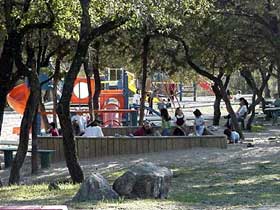 Children
have been playing in sand for many centuries. It is difficult to beat the
sensory experience that young children get from being immersed in sand play.
Children
have been playing in sand for many centuries. It is difficult to beat the
sensory experience that young children get from being immersed in sand play.
Here are some considerations to keep in mind for sand play on your play yard:
- Locate the sandbox in a shady area, preferably away from the building
- Locate the sandbox away from high traffic areas
- Go to the gravel company and select your own sand-you are looking for
a mix that brushes off easily
- Consider ADA access into the sandbox by providing a transfer deck for
children using wheelchairs
- Provide 6" steps into the sandbox for toddlers, two's or children
with mobility problems
- Remember to provide access to your sand box by truck to replenish the
sand as needed
- Provide a cover for your sandbox, both Grounds for Play and Benee's
Toys make custom sand box covers. As a last resort, use a tarp weighted
down with bricks.
- Provide a ledge for teachers to sit on around the outside-this also makes
a great roadway
- Develop rules for the use of the sandbox
- Provide numerous and ample props for the children to experiment
- Replace the sand every two years with clean sand. Do not sanitize with
chemicals
Some parents are opposed to the use of sand since it might be difficult to
remove the sand from children whose hair might be braided or if pom-aid is
used to help in the braiding. Sometimes a shower cap can be utilized to protect
the hair. Other sensory experiences that can be provided outdoors in the place
of sand might be pine cones, larger smooth rocks, leaves or with older children
pea gravel. Pea gravel is not recommended for younger children as they will
put it in their nose and ears.
Sand is usually sold by the cubic yard. To calculate the amount you need,
multiply the length (in feet) times the width (in feet) times the depth (in
feet). This will give you the number of cubic feet you need. For each 27 cubic
feet (or fraction thereof) you will need one cubic yard of sand. For examples,
a sand box that is seven feet wide, nine feet long and one foot deep would
be calculated: 7' x 9'=63 x 1'=63. 63 square feet divided
by 27=2.3 cu yds. One would need three cubic yards of sand. Depending on how
high the sides of your sand box are, you might have areas of sand, such as
in the middle, that are deeper than 12 inches. It is wise to order more sand
that you need since you might need to also replenish your indoor sand tables
at the same time.
Vol. III, No. 4, April 2004
- What Makes Space Work? (www.whitehutchinson.com/ news/ learnenews/ 2004/ 04/ article101.shtml#article)
- What Makes Outdoor Sand Play Work? (www.whitehutchinson.com/ news/ learnenews/ 2004/ 04/ article102.shtml#article)
- Wiring Could Pose Lead Risk (www.whitehutchinson.com/ news/ learnenews/ 2004/ 04/ article103.shtml#article)
- Passive Smoking Is a Threat to Children (www.whitehutchinson.com/ news/ learnenews/ 2004/ 04/ article104.shtml#article)
- Resource Guide on Children's Environmental Health (www.whitehutchinson.com/ news/ learnenews/ 2004/ 04/ article105.shtml#article)
- Recent Projects (www.whitehutchinson.com/ news/ learnenews/ 2004/ 04/ article106.shtml#article)
- Early Childhood Facilities Design Institute Remains a Bargain (www.whitehutchinson.com/ news/ learnenews/ 2004/ 04/ article107.shtml#article)
[ Index of Previous eNewsletters (www.whitehutchinson.com/ news/ learnenews/ previous.shtml) ]
Mailing Address: White Hutchinson Leisure & Learning Group, 4036 Baltimore Avenue, Kansas City, Missouri 64111, USA
Telephone: +1.816.931-1040, Fax: +1.816.756-5058
E-mail: Please direct all messages for Leisure, Entertainment and Recreation Projects to Randy@whitehutchinson.com; and all messages for Children's Learning and Play Projects to Vicki@whitehutchinson.com.
© 1999 - 2026, White Hutchinson Leisure & Learning Group, Inc.
The contents of this website and eNewsletters are protected by USA and international copyright law. Permission is granted to download and print single copites of any of the contents or articles for personal use. No other copies may be made. Educational institutions may obtain permission to make multiple copies for classroom use by e-mailing us with details. The contents of articles may be quoted provided credit is given to the "(author's name), White Hutchinson Leisure & Learning Group, Kansas City, MO, USA". All other rights for use or reproduction of the contents and articles are reserved.