
This is a print-friendly version of www.whitehutchinson.com/news/agrinews/2026/august/article104.shtml

[ Index of Previous eNewsletters (www.whitehutchinson.com/ news/ agrinews/ previous.shtml) ]
Several decades ago, agritourism success followed a relatively straightforward formula. Plant pumpkins. Design a corn maze. Offer hayrides. Add a petting zoo. Invite school field trips. For many farms, these elements transformed seasonal agriculture into thriving destination businesses. Families flocked to fall festivals, school buses filled parking lots, and autumn weekends became synonymous with pumpkins, cider donuts, kettle corn, hayrides, and harvest traditions. That formula built today's agritourism industry. However, the industry has continued to evolve and is now entering a new stage of maturity.
Consumers haven't stopped loving pumpkin patches, sunflower fields, corn mazes, u-pick orchards, or farm visits. What has changed is how they choose where to spend their leisure time and what they expect when they arrive.
In many regions, guests can now choose from numerous farms offering remarkably similar features, attractions, and experiences. At the same time, demographic change, economic stratification, evolving lifestyles, and shifting leisure preferences are reshaping both the customer base and the experiences people seek. Increasingly, consumers start with an occasion rather than asking what activity they want to do. They ask, "What should we do this weekend?""Where should we celebrate?" or "Where can we spend quality time together?" Only after deciding on the occasion, do they choose the destination.
That seemingly subtle shift has profound implications. It changes who today's guests are, what they value, where farms should invest, and ultimately what separates agritourism's most successful operations from the rest.
Farm features such as orchards, pumpkin patches, vineyards, barns, meadows, and ponds, along with attractions such as corn mazes, hayrides, petting zoos, giant slides, and jumping pillows, remain the foundation of successful agritourism. Increasingly, however, they serve as the backdrop for something much larger: memorable occasions that bring people together, strengthen relationships, and become traditions guests look forward to repeating year after year.
Five strategic shifts are driving this evolution.
The first shift is demographic, but its implications extend well beyond population statistics.
For decades, agritourism growth depended primarily on families with children. That market remains important to most farms. Since U.S. births peaked in 2007, declining birth rates have resulted in about 8 million fewer children than would have been born if birth rates had stayed at 2007 levels. Simply put, the pool of future customers for businesses focused almost exclusively on children is gradually shrinking.
At the same time, adults without children, including singles, dual-income couples without children (DINKs), cohabiting couples, and empty nesters, represent a growing share of households and of discretionary leisure spending. 73% of households currently don't have any children. These consumers often have greater scheduling flexibility, higher disposable incomes, and different motivations for visiting farms. They are drawn to exceptional food and beverages, live music, wellness, gardening, educational experiences, and authentic rural settings.
Families are changing as well. A generation ago, many parents primarily sought places that entertained their children. Today, they increasingly choose destinations they will genuinely enjoy, ensuring their children have a good time as well. The goal is no longer simply keeping children occupied. It is spending meaningful time together.
Adults are changing as well. Both parents and adults without children increasingly seek adult-only experiences on evenings and weekends, creating opportunities for farms to serve entirely different market segments beyond the traditional family market.
None of these changes diminish the importance of families. Instead, they expand the opportunity to serve a broader range of guests year-round.
Future growth depends not only on continuing to serve families well but also on intentionally creating adult-only occasions that extend visitation beyond the traditional family market.
Understanding who is visiting is only the first step. Equally important is understanding what those guests now expect, and those expectations are increasingly diverging.
Another important shift is occurring not in who visits farms, but in what different groups of consumers now expect.
The K-shaped economy (www.whitehutchinson.com/ news/ agrinews/ 2026/ july/ article105.shtml#article) has widened the gap in Americans' leisure spending. Higher-income households account for a growing share of discretionary spending and increasingly seek premium experiences. They willingly pay for exceptional food, beautiful settings, outstanding hospitality, and unique events that feel distinctive and worth sharing.
At the same time, expectations have risen across nearly every income level. Guests notice food quality, cleanliness, customer service, attractive gathering spaces, thoughtful design, convenient online ticketing, and the overall atmosphere. Those details are no longer extras; they are now part of the experience itself.
Many middle-income families, however, face a different reality. Years of inflation have driven up the cost of housing, groceries, insurance, healthcare, and other everyday necessities, leaving less discretionary income for entertainment. They continue to seek enjoyable experiences, but they have become far more selective. Every leisure purchase is evaluated more carefully, and destinations must clearly demonstrate value for the money.
This growing divergence means agritourism operators can no longer assume a single experience fits every guest. Some farms will succeed by creating premium experiences for adults and families willing to pay more for elevated food, hospitality, and memorable occasions. Others will differentiate by delivering exceptional value. Increasingly, the strongest businesses will intentionally pursue both through a barbell strategy of offering premium experiences that command higher prices while maintaining affordable options accessible to middle-income families.
Consumer expectations are no longer moving in a single direction. They are diverging. The farms most likely to succeed will clearly identify the customer segments they aim to serve and intentionally design experiences that deliver premium value, exceptional affordability, or both.
The first two shifts explain who today's customers are and what they expect. The third explains how they choose where to spend their leisure time.
Perhaps the most significant change in consumer behavior is that people increasingly decide why they want to go out before deciding where to go.
Twenty years ago, many guests started with an activity in mind. They wanted to pick apples, ride a hay wagon, explore a corn maze, or visit a petting zoo. Today, they are more likely to start with an occasion. They ask where they can celebrate a birthday, spend quality time with family, enjoy a date night, entertain visiting friends, reconnect with other couples, or simply escape everyday routines for a few hours. That shift fundamentally expands the role agritourism can play in people's lives.
An orchard becomes more than a place to pick apples. It becomes the setting for a farm-to-table dinner, a photography workshop, or an anniversary celebration. A meadow becomes more than open space. It becomes the venue for concerts, outdoor movies, yoga classes, or wellness retreats. Even a traditional hayride can be part of a harvest festival, a family reunion, or a holiday tradition.
The farm itself may change very little, but the occasions built around it can continually evolve.
That changes the questions operators should ask when planning for the future. Rather than asking, "What attraction should we add next?" a better question is, "What occasions do we want our farm to own?"
That subtle shift shifts the focus away from continually adding more things to do and toward creating experiences people want to share with those who matter most to them.
Farm features and attractions answer the question, "What can we do?"
Programming answers, "What's happening?"
Occasions answer, "Why are we coming?" The most successful farms intentionally design experiences around the occasions their guests want to enjoy.
As occasions become more important, another competitive factor also gains importance: hospitality.
As occasions become more important, so does hospitality.
Guests rarely remember only the apples they picked or the hayride they took. They remember whether the farm felt welcoming, whether the food exceeded expectations, whether they found comfortable places to relax, and whether everyone in their group genuinely enjoyed spending time together.
Hospitality today extends far beyond customer service. It encompasses the entire guest experience from online ticket purchasing and arrival to food quality, cleanliness, seating, landscaping, signage, restrooms, and the friendliness of every employee that a guest encounters. Increasingly, those details shape how people remember the visit long after they leave.
For farms seeking to attract adults as well as families, hospitality often becomes the deciding factor. Adults who may have little interest in a petting zoo or a giant slide are far more likely to visit for exceptional food, local beverages, beautiful scenery, live music, or an evening that feels relaxing and authentic. Families benefit as well since parents increasingly choose destinations they genuinely enjoy rather than places designed solely for children.
Hospitality also encourages people to linger. Comfortable seating under shade trees, inviting patios overlooking fields, fire pits, picnic lawns, and thoughtfully designed gathering spaces naturally extend the visit. Guests stay longer, order another drink or dessert, browse the farm market, and leave with a stronger emotional connection to the farm.
In many ways, hospitality has become a competitive advantage in its own right. Two farms may offer similar orchards, corn mazes, hayrides, and seasonal events, yet the farm that offers a warmer welcome, better food, more inviting gathering spaces, and a more memorable atmosphere is far more likely to earn repeat visits and enthusiastic recommendations.
Hospitality is no longer merely supporting the experience; it increasingly defines it. Farm features and attractions may draw guests to the farm, but hospitality often determines how long they stay, how much they spend, whether they return, and whether they recommend the experience to others.
If hospitality elevates every visit, programming multiplies the value of everything the farm already has. It creates new reasons to visit, introduces the farm to new audiences, and continually gives previous guests compelling reasons to come back.
Farm features and attractions form the foundation of agritourism. Programming unlocks their full potential.
Programming does something permanent farm features and attractions cannot accomplish by themselves. It creates new occasions that attract different guest segments while continually giving previous visitors fresh reasons to return.
An orchard that offers only apple picking primarily appeals to people who want to pick apples. The same orchard can also host blossom walks in the spring, chef dinners in the rows of trees, cider tastings, photography workshops, wellness retreats, and holiday lighting experiences. The orchard itself hasn't changed. What has changed is the number of reasons people now have to visit it.
Programming broadens a farm's appeal by creating experiences that resonate with couples, adults without children, homeschool families, retirees, food enthusiasts, gardeners, photographers, and many other customer segments. Rather than relying on the same visitors to return for the same seasonal activities, programming creates entirely new occasions that attract people who may never have considered visiting the farm.
Just as importantly, programming continually gives previous guests fresh reasons to come back. A family that visits for a pumpkin festival in October may return for holiday lights, a spring blossom festival, a summer concert, or a gardening workshop. Couples who first discover the farm during a farm-to-table dinner may later return for cider tastings, live music, or an anniversary celebration.
Programming therefore serves two equally important strategic purposes. It creates appeal by attracting new audiences and new occasions. It also builds repeat appeal by continually giving existing guests compelling reasons to return. Together, those two benefits make programming one of the most powerful competitive advantages a farm can develop.
Programming unlocks the full potential of a farm's existing features and attractions. Families may visit for pumpkin festivals, couples for evening dinners, retirees for gardening workshops, homeschool families for educational programs, young professionals for concerts, and food enthusiasts for seasonal tastings. The farm itself changes very little, but the audiences, occasions, and reasons to visit continually expand.
Programming transforms a farm's existing assets into a continually evolving calendar of memorable occasions. These occasions broaden the farm's appeal to new audiences while encouraging previous guests to return more often. Repeated occasions become traditions. Traditions build loyalty. And loyalty is one of the few competitive advantages that competitors cannot easily replicate.
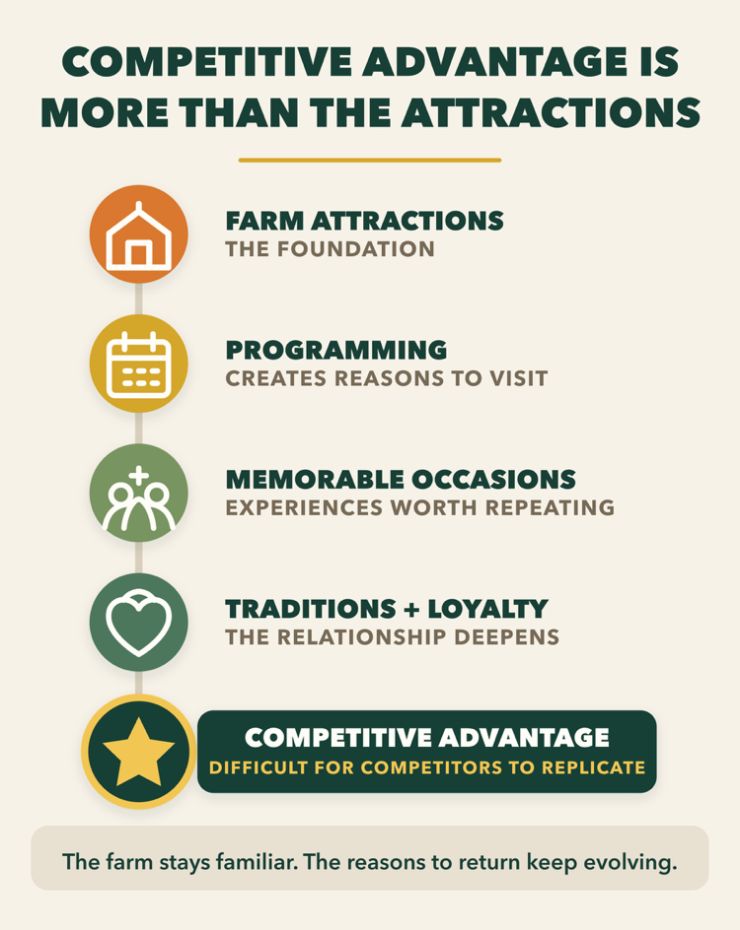
Agritourism is no longer simply a collection of farm features, attractions, and seasonal experiences. It is evolving into a business centered on memorable occasions.
Orchards, pumpkin patches, vineyards, meadows, corn mazes, hayrides, petting zoos, farm markets, and u-pick experiences will continue to draw millions of visitors each year. They remain the industry's foundation. Increasingly, however, guests are looking for something more. They want places to celebrate milestones, reconnect with family and friends, enjoy exceptional food, experience authentic hospitality, and create traditions they look forward to repeating year after year.
The farms that thrive over the next decade will not necessarily be those with the biggest attractions or the largest corn mazes. They will be the farms that best understand how consumer lifestyles, demographics, and leisure preferences are evolving and then intentionally design experiences around those changes.
One of our company's distinguishing capabilities has always been identifying emerging consumer, demographic, and leisure trends before they become mainstream. Rather than simply studying today's successful farms and following their lead, we focus on understanding where consumers are headed next. Designing for tomorrow's guests, not yesterday's successes, creates lasting competitive advantage.
The future of agritourism belongs to farms that understand this progression:
Our company is currently working with a traditional commodity farm on developing an agritourism venue that will be based on developing the facility specifically to support year-round weekly activity programming for multiple visitor segments.
Subscribe to Agritourism Today (www.whitehutchinson.com/ subscribe/ agrinews/ )
[ Index of Previous eNewsletters (www.whitehutchinson.com/ news/ agrinews/ previous.shtml) ]
© 1999 - 2026, White Hutchinson Leisure & Learning Group, Inc.
The contents of this website and eNewsletters are protected by USA and international copyright law. Permission is granted to download and print single copites of any of the contents or articles for personal use. No other copies may be made. Educational institutions may obtain permission to make multiple copies for classroom use by e-mailing us with details. The contents of articles may be quoted provided credit is given to the "(author's name), White Hutchinson Leisure & Learning Group, Kansas City, MO, USA". All other rights for use or reproduction of the contents and articles are reserved.